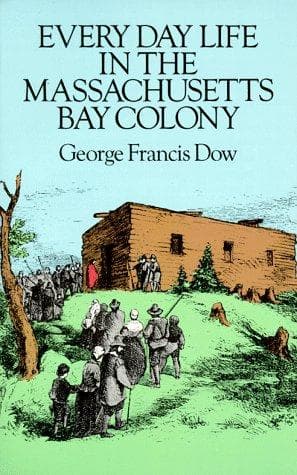
Every Day Life in the Massachusetts Bay ColonyDow, George Francis
History
Every Day Life in the Massachusetts Bay Colony
Dow, George Francis
Massachusetts -- Social life and customs -- To 1775
Clocks were seldom found in the farmhouse. Noon marks and sundials
answered the needs of the family and when the day was cloudy, one
must "guess." Because so many had no means of telling the time, it
was customary to make appointments for "early candlelight."
It was usual with most families to gather roots and herbs to be used
for medicinal purposes. Catnip, pennyroyal, sage, thoroughwort,
spearmint, tansy, elderblows, wormwood, and other plants were saved
to be used in case of sickness. Gold thread or yellow root was saved
and was a remedy for canker in the mouth. Many of the old women who
had reared families of children were skilful in the use of these
remedies, and were sent for in case of sickness, and would prescribe
teas made from some of these herbs, which were cut when in bloom and
tied in small bundles and suspended from the rafters on the garret
to dry, causing a pleasant aromatic smell in the upper part of the
house.
The well was usually at some distance from the farmhouse and often
located in an exposed and wind-swept position requiring much daily
travel over a snowy and slippery path in winter and through mud and
wet at other times. Convenience in the location of the well was in
too many cases overlooked. From the well all the water used for
domestic purposes was brought into the house in buckets. The water
in the well was usually drawn by means of a well-sweep.
In some towns the selectmen were chosen by "pricking." A number of
names were written upon a sheet of paper. This was passed around
and each man pricked a hole against the names of his choice. The
one having the most pin holes was chosen first selectman, the next
highest the second, and the next the third.
When a couple concluded to marry they made known their intention to
the town clerk, who posted a notice of their intended marriage in
the meetinghouse. This was called "being published." By law this
notice must be published three Sabbaths before the ceremony was
performed, so that any one who knew of any reason why such marriage
should not take place might appear and make objection. In addition
to the posting, the town clerk would rise in the meeting and read
the intention to marry.
Each landowner not only maintained his own fences around cultivated
fields, but also gave of his labor in building long ranges of
fencing about the common pasture lands in proportion to his interest
in the land. A law was enacted as early as 1633 requiring the
fencing of corn fields.
Public-domain text, read in full here on John Shaqi.
Reviews
Reviews
No reviews yet
Be the first to share your thoughts on this work.
Elsewhere in the archive
Join the Discussion
Join the discussion
Sign in to leave a comment or review.
Sign InorCreate an account