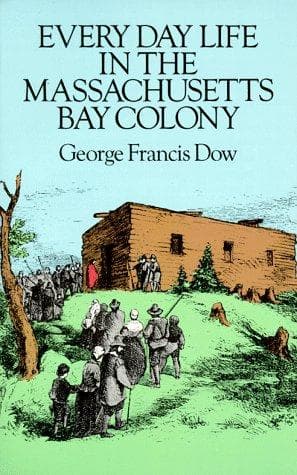
Every Day Life in the Massachusetts Bay ColonyDow, George Francis
History
Every Day Life in the Massachusetts Bay Colony
Dow, George Francis
Massachusetts -- Social life and customs -- To 1775
The earliest fences were usually made of five rails and must be up
by early in April when the cattle and hogs were turned out to roam
at large. The New England farmer, clearing his land for cultivation,
soon devised another form of fence where stones were plentiful and
by piling up these stones into walls divided off his fields and
gave them substantial protection. The well-built stone wall must
have a foundation of small stones laid in a trench to prevent its
being thrown by the frost and when carefully built it would last
for generations. Meanwhile the adjoining field had been cleared
of stones and made useful for cultivation. Hedge fences were also
in frequent use as in parts of England whence the settlers had
emigrated.
The roads outside the villages were seldom fenced. In fact, the
early roads were little more than ill-defined paths winding their
way across pastures and cultivated fields and whenever a dividing
farm was reached, there would be a gate or bars to be opened and
closed by the traveler.
CHAPTER VIII
MANNERS AND CUSTOMS
When the first considerable emigration ceased about the year
1640, of the 25,000 settlers then living in the Colony, probably
ninety-five per cent were small farmers or workmen engaged in the
manual trades, together with many indentured servants who had come
over under the terms of a contract whereby they were bonded to
serve their masters for a term of years--usually five or seven. The
remaining five per cent of the population was composed of those
governing the colony--the stockholders in the Company, so to speak;
ministers enough to supply the spiritual needs of each town and
settlement, however small; a few of social position and comparative
wealth; one lawyer; and a sprinkling of shopkeepers and small
merchants living in the seaport towns. Here and there a physician
or chirurgeon might be found, but the physical welfare of the
smaller towns was usually cared for by some ancient housewife with
a knowledge of herbs and simples. Sometimes it was the minister who
practiced two professions and cared for the bodies as well as the
souls of his congregation.
Public-domain text, read in full here on John Shaqi.
Reviews
Reviews
No reviews yet
Be the first to share your thoughts on this work.
Elsewhere in the archive
Join the Discussion
Join the discussion
Sign in to leave a comment or review.
Sign InorCreate an account