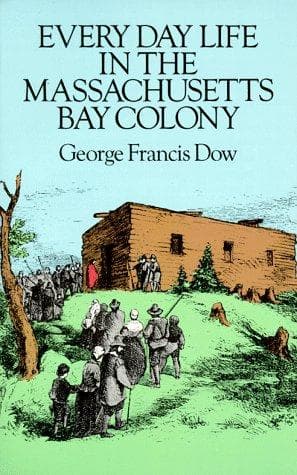
Every Day Life in the Massachusetts Bay ColonyDow, George Francis
History
Every Day Life in the Massachusetts Bay Colony
Dow, George Francis
Massachusetts -- Social life and customs -- To 1775
But these hardships and inconveniences of living which the New
England colonists met and overcame differ but little from those
experienced in every new settlement. They have been paralleled
again and again wherever Englishmen or Americans have wandered.
In a few years after the coming of the ships much of the
rawness and discomfort must have disappeared, certainly in the
early settlements, and comparative comfort must have existed
in most homes. If we could now lift the roof of the average
seventeenth-century house in New England it is certain that we
should find disclosed not only comfortable conditions of living but
in many instances a degree of luxury with fine furnishings that is
appreciated by few at the present time.
Of the early days following the settlement Roger Clap, who lived at
Dorchester, afterwards wrote as follows:
"It was not accounted a strange thing in those days to drink water,
and to eat Samp or Homine without Butter or Milk. Indeed it would
have been a strang thing to see a piece of Roast Beef, Mutton or
Veal; though it was not long before there was Roast Goat. After the
first Winter, we were very Healthy: though some of us had no great
Store of Corn. The Indians did sometimes bring Corn, and Trade with
us for Clothing and Knives; and once I had a Peck of Corn, or there
abouts, for a little Puppy-Dog. Frostfish, Muscles and Clams were a
Relief to Many."
When Governor Winthrop landed at Salem in June, 1630, he supped on
a good venison pasty and good beer, while most of those who came
with him went ashore on Cape Anne side (now Beverly) and gathered
strawberries. That was a fine beginning, but when winter set in many
of them were "forced to cut their bread thin for a long season"
and then it was that they fully realized that "the Ditch betweene
England and their now place of abode was so wide.... Those that were
sent over servants, having itching desires for novelties, found a
reddier way to make an end of their Master's provision, then they
could finde means to get more; They that came over their own men
had but little left to feed on, and most began to repent when their
strong Beere and full cups ran as small as water in a large Land....
They made shift [however] to rub out the Winter's cold by the
Fireside, having fuell enough growing at their very doores, turning
down many a drop from the Bottell, and burning Tobacco with all the
ease they could."[38]
[38] Edward Johnson, _Wonder Working Providence_, London, 1654.
Lacking bread they lived on fish, mussels and clams. The rivers
supplied bass, shad, alewives, frost fish and smelts in their
season, also salmon, and corn meal could be bartered for with the
Indians and shortly raised from seed.
Public-domain text, read in full here on John Shaqi.
Reviews
Reviews
No reviews yet
Be the first to share your thoughts on this work.
Elsewhere in the archive
Join the Discussion
Join the discussion
Sign in to leave a comment or review.
Sign InorCreate an account