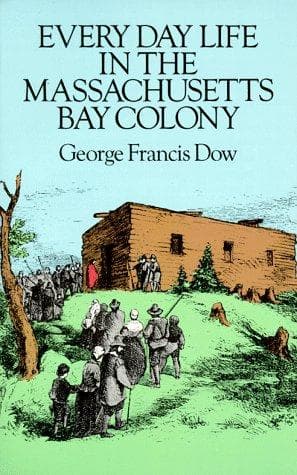
Every Day Life in the Massachusetts Bay ColonyDow, George Francis
History
Every Day Life in the Massachusetts Bay Colony
Dow, George Francis
Massachusetts -- Social life and customs -- To 1775
Drunkenness was very common in the old days. "We observed it a
common fault in our young people that they gave themselves to drink
hot waters immoderately," wrote Edward Johnson. Every family kept
on hand a supply of liquor and wine, and cider was considered a
necessity of daily living in the country, where it was served with
each meal and also carried into the fields by the workers. It was
stored in barrels in the cellar and the task of drawing the cider
and putting on the table usually fell to the younger members of the
family. A man would often provide in his will for the comfort of
his loving wife by setting aside for occupancy during her life, one
half of his house, with a carefully specified number of bushels of
rye, potatoes, turnips and other vegetables; the use of a horse with
which to ride to meeting or elsewhere; and lastly, the direction
that annually she be provided with a certain number of barrels of
cider--sometimes as many as eight.
Rev. Edward Holyoke, the President of Harvard College, was in the
habit of laying in each year thirty or more barrels of cider as he
had to provide for much entertaining. Late in the winter he would
draw off part of his stock and into each barrel he would pour a
bottle of spirit and a month later some of this blend would be
bottled for use on special occasions.
What was their conduct not only in their homes but in their
relations with their neighbors? Did they live peaceably and work
together in building up the settlements? Did they set up in the
wilderness domestic relations exactly like those they had abandoned
overseas? It was a raw frontier country to which they came and it is
apparent that at the outset they felt themselves to be transplanted
Englishmen. So far as possible they lived the lives to which they
had been accustomed and they engrafted in their new homes the
manners and customs of the generations behind them. Most of them
fully recognized, however, that they were not to return; that they
had cut loose from the old home ties and it was not long before
the necessities and limitations of frontier life brought about
changed conditions in every direction. Politically, religiously
and socially, they were in a different relation than formerly in
the English parish life. Many of them, especially those somewhat
removed from the immediate supervision of magistrate and minister,
before long seem to have shown a tendency to follow the natural
bent of the frontiersman toward independent thought and action.
Their political leaders made laws restricting daily life and action
and their religious leaders laid down rules for belief and conduct,
that soon were repellent to many. Civil and clerical records are
filled with instances showing an evasion of and even contempt for
the laws and rules laid down by the leaders of their own choosing.
Some of it doubtless was in the blood of the men who had come in
search of a certain individual freedom of action, but much of it may
Public-domain text, read in full here on John Shaqi.
Reviews
Reviews
No reviews yet
Be the first to share your thoughts on this work.
Elsewhere in the archive
Join the Discussion
Join the discussion
Sign in to leave a comment or review.
Sign InorCreate an account