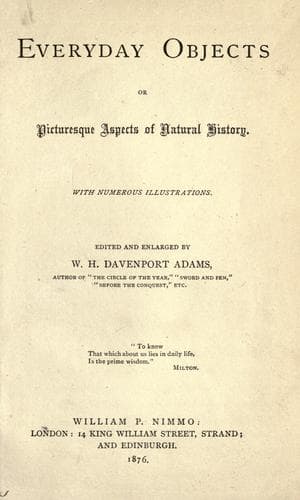
Everyday Objects; Or, Picturesque Aspects of Natural History.Adams, W. H. Davenport (William Henry Davenport)
History
Everyday Objects; Or, Picturesque Aspects of Natural History.
Adams, W. H. Davenport (William Henry Davenport)
Natural history
[Footnote 62: Tragus, "Historia Stirpium," p. 310 (ed. 1552).]
[Footnote 63: Fabius Columna (Fabio Colonna), an Italian man of
science, who died in 1650, at the age of eighty-three.]
[Footnote 64: Thomas Campbell.]
[Footnote 65: Anne Pratt, "Flowers and their Associations" (ed.
1846).]
[Footnote 66: _Draba aretoides_ has been found on Chimborazo at
16,000 feet.]
[Footnote 67: _Poa annua_ grows at an elevation of 7400 feet.]
[Footnote 68: Aristotle, "Hist. Animal.," i. 9.]
[Footnote 69: Pliny, "Hist. Nat.," xi. 52.]
[Footnote 70: Pliny, "Hist. Nat.," xxx. 7, 12, 24.]
[Footnote 71: Pliny, "Hist. Nat.," xi. 36.]
[Footnote 72: Newman, "Introduction to the History of British
Insects."]
BOOK IV.
AUTUMN.
"Where are the songs of spring? Ay, where are they?
Think not of them; _thou_ hast thy music too,
While barred clouds bloom the softly dying day,
And touch the stubble-plains with rosy hue;
Then in a wailful choir the small gnats mourn
Among the river shallows, borne aloft
Or sinking as the light wind lives or dies;
And full-grown lambs loud bleat from hilly bourn;
Hedge crickets sing; and now with treble soft
The redbreast whistles from a garden croft,
And gathering swallows twitter from the skies."
--KEATS.
* * * * *
"It was a fair and mild autumnal sky,
And earth's ripe pleasures met the admiring eye,
As a rich beauty, when her bloom is lost,
Appears with more magnificence and cost."
--CRABBE.
[Illustration]
CHAPTER I.
_WHAT MAY BE SEEN IN THE HEAVENS._
"The contemplation of the works of creation elevates the mind to
the admiration of whatever is great and noble, accomplishing the
object of all study, which is to inspire the love of truth, of
wisdom, of beauty, especially of goodness, the highest beauty,
and of that supreme and eternal Mind which contains all truth and
wisdom, all beauty and goodness."--MARY SOMERVILLE.
[Illustration]
To discern the luminous point which should guide us in the shadows of
the infinite, is the gift of genius. The first to discern this point
in astronomy, the illustrious Kepler thereby succeeded in formulating
those laws, or rather rules, by which the movements of the stars are
regulated. How did he succeed? How did he arrive at a goal so much
to be desired? By intelligence in full possession of itself. It was
by abstracting his thoughts from all systematic conceptions,--the
shackles of science; it was by defying the traditional authority
which had so long enslaved men's minds; it was by interrogating
nature, which leaves all liberty to her interrogator, that Kepler
was able to deserve and win the glorious title of "legislator of
the heavens,"--a title which we must not, however, understand too
literally; it bears witness only to the power of intellect.
Public-domain text, read in full here on John Shaqi.
Reviews
Reviews
No reviews yet
Be the first to share your thoughts on this work.
Elsewhere in the archive
Join the Discussion
Join the discussion
Sign in to leave a comment or review.
Sign InorCreate an account