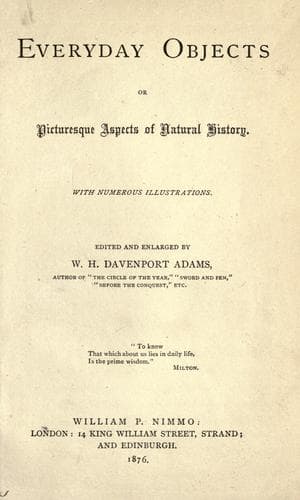
Everyday Objects; Or, Picturesque Aspects of Natural History.Adams, W. H. Davenport (William Henry Davenport)
History
Everyday Objects; Or, Picturesque Aspects of Natural History.
Adams, W. H. Davenport (William Henry Davenport)
Natural history
Let us attempt, at a modest distance, to proceed like Kepler; let us
make astronomy without troubling ourselves concerning astronomers.
This is the sole means of seizing the luminous point which should
guide our steps.
* * * * *
The movement, in virtue of which every star performs the circuit
of heaven in four-and-twenty hours, is incessantly reproduced in a
uniform and a constant manner. The acquisition of this first fact,
simple as it seems, was a somewhat laborious task, and undoubtedly
dates back to a distant antiquity. But now comes another fact, where
observation demands the closest mental attention, and which is of a
more recent discovery.
To comprehend it clearly, let us first call to mind that the moment
when the sun crosses the Equator,--whether to return into the
northern hemisphere (at the _spring equinox_), or into the southern
(at the _autumn equinox_),--is instantaneous. More than one way
exists of determining this moment exactly; but here we need not enter
upon the subject.
Is the interval of time occupied by the sun in travelling from the
spring to the autumn equinox equal to the interval which our luminary
requires to pass from the autumn equinox to the vernal?
A singular question, you reply. Who, indeed, would venture to
maintain that the number of days, hours, minutes, seconds, was not
exactly the same in the one case as in the other?
Well, the period is _not_ the same; and, therefore, merely to
propound _this_ question was a masterpiece of genius. For no ordinary
intellectual audacity was needed to doubt the reality of the supposed
perfect circle which the sun apparently describes--according to the
recognised authorities--in its uniform progress around the globe;
that globe believed by all the early astronomers to be imperturbably
and everlastingly situated in the centre of their thrice-sacred
geometrical figure. This dogma being accepted as infallible, there
was every evidence that the two intervals of time, which divided the
astronomical year into two moieties, would be of equal duration. It
did not occur to the mind of any one of the faithful that the sojourn
of the sun, in his circular and uniform movement, might be longer or
shorter in the northern than in the southern hemisphere.
What, then, was the name of the audacious innovator who ventured upon
putting forth so revolutionary a suggestion?
Public-domain text, read in full here on John Shaqi.
Reviews
Reviews
No reviews yet
Be the first to share your thoughts on this work.
Elsewhere in the archive
Join the Discussion
Join the discussion
Sign in to leave a comment or review.
Sign InorCreate an account