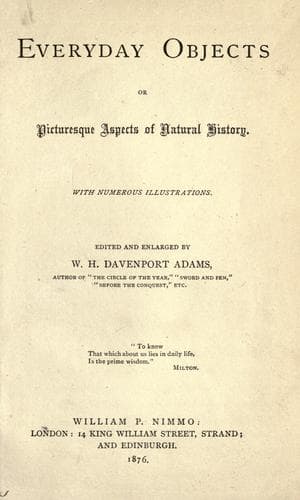
Everyday Objects; Or, Picturesque Aspects of Natural History.Adams, W. H. Davenport (William Henry Davenport)
History
Everyday Objects; Or, Picturesque Aspects of Natural History.
Adams, W. H. Davenport (William Henry Davenport)
Natural history
It was Hipparchus. At least it was he who, confidently relying upon
his observations, was the first to affirm that the sun remains longer
in the northern than in the southern hemispheres; or, more accurately
speaking, that its passage from the spring to the autumn equinox
occupies 187 days, while from the autumn to the spring equinox the
duration of its course is only 178 days 6 hours (nearly). The year
of 365-1/4 days--that is, the Egyptian year, which was universally
adopted by the ancient astronomers--was thus discovered to be really
divided into two unequal portions, although, _theoretically_, the sun
ought to occupy exactly the same space of time in passing from the
spring to the autumn, as from the autumn to the spring equinox.
* * * * *
The fact pointed out and attested by Hipparchus had an influence
which he never anticipated on the progress of science. In opposition
to all the systems previously designed by man, it followed, in the
first place, that the movement of the sun, in relation to a mean
movement, must sometimes be accelerated, sometimes be retarded; that
the solar arc described in a given time would be greater in winter
than in summer.
Astronomers who, trammelled by particular theories, were unable
and unwilling to accept of any new light, immediately hastened
to raise, as is invariably the case with those who defend a bad
cause, a subsidiary and damaging question. They asked whether those
inequalities of the sun's movement were real, or only apparent;
whether they were more than a mere optical phenomenon, arising
from the sun's position _vis-à-vis_ to an observer placed on the
earth's surface. And they unhesitatingly pronounced in favour of the
appearance, and against the reality.
But man, says an old adage, is always punished after the manner
of his sin. Dogmatic and obstinate authority involved our
anti-revolutionary astronomers in fresh complications. Such is the
case, too, very frequently, in the domain of theology!
Does the sun--the sun as each of us beholds him--ever change his
size? Does he ever shrink in his majestic proportions? Is the
magnitude of his broad golden disc ever lessened?
* * * * *
Public-domain text, read in full here on John Shaqi.
Reviews
Reviews
No reviews yet
Be the first to share your thoughts on this work.
Elsewhere in the archive
Join the Discussion
Join the discussion
Sign in to leave a comment or review.
Sign InorCreate an account