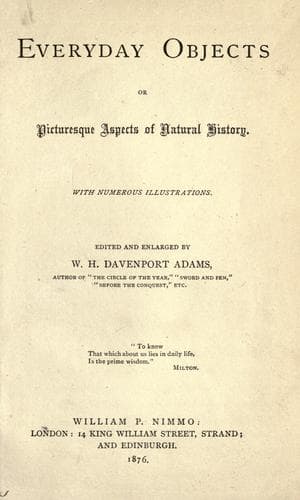
Everyday Objects; Or, Picturesque Aspects of Natural History.Adams, W. H. Davenport (William Henry Davenport)
History
Everyday Objects; Or, Picturesque Aspects of Natural History.
Adams, W. H. Davenport (William Henry Davenport)
Natural history
It is this reflection which must always teach humility to the
scientific student, even while he rejoices in the achievements of
human patience and genius. He will not despair for he knows that
great victories have been won: he will not grow arrogant, for he
knows that he is still on the threshold of eternal truth. As Sir
J. Herschel has justly said:--"He who has seen obscurities, which
appeared impenetrable, in physical and mathematical science, suddenly
dispelled, and the most barren and unpromising fields of inquiry
converted, as if by inspiration, into rich and inexhaustible springs
of knowledge and power, on a simple change of our point of view, or
by merely bringing them to bear on some principle which it never
occurred before to try, will surely be the very last to acquiesce
in any dispiriting prospects of either the present or the future
destinies of mankind; while, on the other hand, the boundless views
of intellectual and moral, as well as material relations, which open
to him on all hands in the course of these pursuits,--the knowledge
of the trivial place he occupies in the scale of creation, and the
sense continually pressed upon him of his own weakness and incapacity
to suspend or modify the slightest movement of the vast machinery
he sees in action around him, must effectually convince him that
humility of pretension, no less than confidence of hope, is what best
becomes his character."[79]
The temperature of the terrestrial surface perpetually varies under
the influence of local as well as general causes. Had this fact
been known to the philosophers of antiquity, they would have taken
advantage of it to liken the earth to an animal whose skin is more or
less sensible of heat, not only according to the difference of the
seasons, but according to the different hours of the day.
The diurnal thermometrical variations are those which penetrate the
least profoundly into the interior of the soil. At a depth of about
five feet they cease to be perceptible. The maxima and minima of the
year, however, can be detected at a sufficiently considerable depth.
The limit descends as low as 80 to 100 feet. Below 100 feet, the
terrestrial stratum is found invariable,--that is, inaccessible to
the thermometrical changes of the atmosphere. It is remarkable that
the temperature of this stratum differs but little from the mean
annual temperature of the air, which, in the latitude of London, is
49°.
* * * * *
Public-domain text, read in full here on John Shaqi.
Reviews
Reviews
No reviews yet
Be the first to share your thoughts on this work.
Elsewhere in the archive
Join the Discussion
Join the discussion
Sign in to leave a comment or review.
Sign InorCreate an account