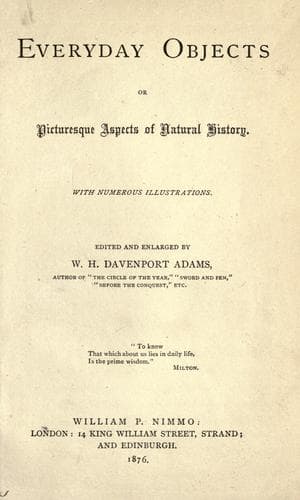
Everyday Objects; Or, Picturesque Aspects of Natural History.Adams, W. H. Davenport (William Henry Davenport)
History
Everyday Objects; Or, Picturesque Aspects of Natural History.
Adams, W. H. Davenport (William Henry Davenport)
Natural history
The maxima and minima of the yearly heat are propagated very slowly
in the earth, and their difference gradually becomes less and
less. Thermometers buried 26 feet deep in the ground, mark, in our
latitudes, the maximum of temperature only on the 10th of December,
and the minimum on the 15th of June. But there are certain elements
which we must take into account. Thus, the depth of the invariable
thermometrical curve depends both on the latitude of the place,
on the conductibility of the strata, and the difference between
the highest and lowest temperature of the year. The less this
difference, the more nearly does the invariable stratum approach the
surface. Here we have the reason why, in the intertropical torrid
zone, where the temperature scarcely varies above two or three
degrees in the whole year, the invariable curve is not found more
than forty centimetres beneath the surface.
* * * * *
In the temperate zone, lying between the torrid and the frigid zones,
the same phenomena assume, apparently, a more complex character;
the isogeothermal lines inflect as diversely as the isothermal, and
the former are far from running parallel with the latter. And this
is easily understood, even without any experiment, for there is no
relation between the ever-varied composition of the terrestrial
strata, and the much more uniform composition of the atmosphere.
In the frigid zone, the soil remains constantly frozen for an
insignificant depth, whatever may be the temperature of the
encircling atmosphere. In some regions a stratum of ice and snow
eternally reposes on the surface of the soil.
Unfortunately the observations, which require to be undertaken on an
uniform plan and under well-weighed conditions, at various points
over the whole globe, are as yet far too few to assist us in defining
any general currents of heat or cold, whether variable or constant,
as prevailing in the lower strata of the gaseous ocean of our planet.
ARABLE LAND.
A more useful picture than that of the isogeothermal lines would be
one of all the arable land covering the continents of the Old World
and the New,--indicating the composition of this nutritive earth, the
nature of the soil on which it reposes, as well as the various kinds
of cultivation appropriate in different climates. Here is a work to
be achieved,--a work which would benefit the whole human race,--a
work differing vastly from the conquests and achievements of too many
of those "heroes" the world delights to honour.
"Peace hath her victories
More renowned than war."
In this immense task, of which, as yet, not even the outlines have
been sketched, particular attention would require to be paid to the
_subsoil_; for upon this the success of all cultivation literally
depends.
Public-domain text, read in full here on John Shaqi.
Reviews
Reviews
No reviews yet
Be the first to share your thoughts on this work.
Elsewhere in the archive
Join the Discussion
Join the discussion
Sign in to leave a comment or review.
Sign InorCreate an account