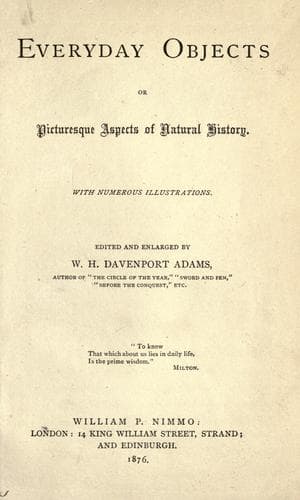
Everyday Objects; Or, Picturesque Aspects of Natural History.Adams, W. H. Davenport (William Henry Davenport)
History
Everyday Objects; Or, Picturesque Aspects of Natural History.
Adams, W. H. Davenport (William Henry Davenport)
Natural history
I was now brought to see that a question so difficult could, like so
many others, be usefully approached only by its _inferior limit_;
in other words, that in the actual condition of botanical science,
we can but affirm the number which certainly _exceeds_ the sum of
the vegetable species scattered over the surface of our earth. To
determine this total with mathematical accuracy, we should need to
have explored the terrestrial crust, liquid and solid, land and
water, from the bed of ocean to the line of perpetual snow, and
from the equator to the poles. And as yet we are very far from
having obtained so complete a possession of the planet which has
been assigned as a dwelling-place to our poor humanity,--alas, more
presumptuous than powerful!
* * * * *
The number of plants mentioned by Theophrastus, Dioscorides, and
Pliny, whom we take to be the representatives of ancient botany,
does not exceed five hundred species. How very few, compared with
the presumable total! The Middle Ages added scarcely anything to the
botanical researches of antiquity. It is only since the discovery of
America that we have seen the domain of Flora extending itself in
unexpected proportions. But we must come down to the epoch of Linnæus
(the middle of the eighteenth century) before we can obtain an
accurate list of species, scientifically classified. Murray's edition
of the "_Specilegium_" of Linnæus contains two thousand and forty-two
species, including the Cryptogams. Wildmore, in another edition of
the same great work, raised the total to twenty thousand. And this
was the point at which our botanists had arrived when the nineteenth
century opened.
But it was not long before they perceived that all these estimates,
large as they seemed, fell immeasurably short of the reality. In
attempting to distribute the different species among the then known
regions of the globe, Alexander von Humboldt arrived at a total of
forty-four thousand species, Phanerogams and Cryptogams included. De
Candolle extended the estimate to upwards of fifty-six thousand.
Let us divide, in fancy, the earth into two parts,--one which has
been visited by travellers, and one which still remains to be
explored. Can you determine which would present the larger area? The
latter.
Public-domain text, read in full here on John Shaqi.
Reviews
Reviews
No reviews yet
Be the first to share your thoughts on this work.
Elsewhere in the archive
Join the Discussion
Join the discussion
Sign in to leave a comment or review.
Sign InorCreate an account