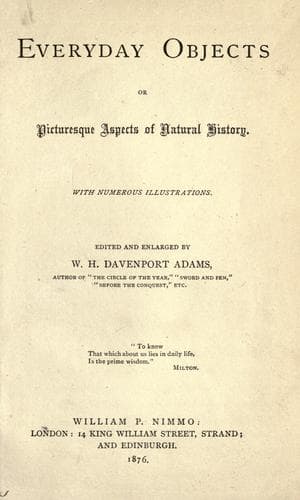
Everyday Objects; Or, Picturesque Aspects of Natural History.Adams, W. H. Davenport (William Henry Davenport)
History
Everyday Objects; Or, Picturesque Aspects of Natural History.
Adams, W. H. Davenport (William Henry Davenport)
Natural history
Thus we possess but a very imperfect knowledge of the luxuriant, the
glowing vegetation of the tropical and sub-tropical regions of the
New World, in spite of the labours of Bates, Agassiz, Wallace, and
others. To the north of the equator, we know very little of the flora
of Yucatan, Guatemala, Nicaragua, the isthmus of Panama, the Chaco
of Antioquius, the province of Los Pastos. We are not much better
acquainted with the vegetation of the countries south of the equator.
What do we know of the manifold species flourishing in Paraguay, in
the province of the Missions, in the immense wooded region between
the Ucayali, the Rio de la Madeira, and the Tocantin, three affluents
of the mighty river Amazon? We know scarcely anything.
Our ignorance increases if from America we pass to Africa. Nearly
the whole interior of this continent, from 15° N. latitude to 20°
S. latitude, is, botanically speaking, a blank to us. The same is
the case with the greater portion of Central Asia. The floras of the
south and south-east of Arabia are still sealed letters,--treasuries
to which we have not found the key. As much may be said of the floras
of the countries situated between the Thian-Schan, the Kuenlung, and
the Himalaya, as well as of the floras of western China, and most of
the trans-Gangetic countries. We know still less of the vegetation of
the interior of Madagascar, Borneo, New Guinea, and the greater part
of Australia. To conclude: we are probably not acquainted with more
than one-fifth of the vegetable species which cover the surface of
our globe.
There are regions, moreover, which we imagine will always lie
outside of our sphere of investigation; such, for instance, are
the Polar regions, properly so called. Undoubtedly, it is open to
us to conjecture that the Poles--those two extremities of our axis
of planetary rotation--are not the home of any form of life. But
this is only a conjecture; we are even without an analogy for it;
since we have found, as shown in an earlier chapter of the present
volume, living beings, plants, and animals, among the snows of our
loftiest mountains. Moreover, might not the auroras, whose maximum
of intensity occurs exactly at the poles, render life possible in
regions where we at present suppose it to be _im_possible? Conjecture
for conjecture,--acknowledge that we here touch in both cases upon an
element completely beyond our human power.
* * * * *
These, then, are the reasons why, at present, we can only venture
upon defining the _lower_ limit, the _restricted_ number, above which
we are unable to fix the total of vegetable species living on the
surface of our planet.
Public-domain text, read in full here on John Shaqi.
Reviews
Reviews
No reviews yet
Be the first to share your thoughts on this work.
Elsewhere in the archive
Join the Discussion
Join the discussion
Sign in to leave a comment or review.
Sign InorCreate an account