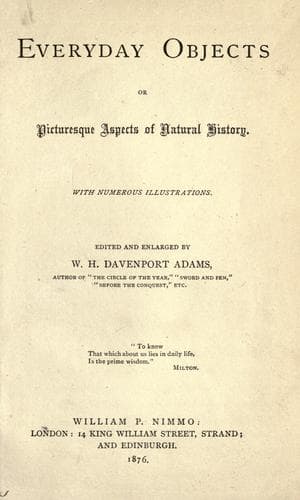
Everyday Objects; Or, Picturesque Aspects of Natural History.Adams, W. H. Davenport (William Henry Davenport)
History
Everyday Objects; Or, Picturesque Aspects of Natural History.
Adams, W. H. Davenport (William Henry Davenport)
Natural history
Herbariums, though their classification is too frequently imperfect,
may furnish us with data of great utility. The great herbarium of
Benjamin Delessert was estimated, after his death, to contain 86,000
species,--a total not widely differing from that which Lindley, in
1835, estimated as the probable aggregate of the vegetable species of
the world.
Great in importance are botanic gardens. Loudon, in his _Hortus
Britannicus_ (ed. 1832), places at 22,660 the number of Phanerogams
cultivated in the gardens of the Bristol amateur botanists. With
this number we must not confound the living species exhibited, in
other counties, in gardens designed for the instruction of students,
nor the grand total reared for a similar purpose at Kew. Kunth's
enumeration, in 1861, of the plants at the Botanic Gardens at Berlin,
one of the richest in Europe, amounted to upwards of 14,000 species,
including 375 heaths. Among the Phanerogams were 1600 Synantheræ,
1150 Leguminosæ, 428 Labiatæ, 370 Umbelliferæ, 460 Orchidaceæ, 60
Palmaceæ, 600 Gramineæ and Cyperaceæ, &c. By comparing these data
with the number of species described in the works of De Candolle,
Walpers, Bentham, Lindley, Kunth, and others, we find that in the
Berlin gardens are cultivated only one-seventh of the known species
of the Synantheræ, one-eighth of the Leguminosæ, one-ninth of the
Gramineæ, and about one-fiftieth of the smaller families, such as the
Labiatæ and Umbelliferæ.
* * * * *
Now, if we admit that, on the one hand, the number of phanerogamous
species cultivated in all the great gardens of Europe is about
30,000, and, on the other, that the cultivated Phanerogams form about
one-eighth part of the species described in books and preserved in
herbariums, we obtain a total of 24,000 species.
But the Cryptogams, or Agams, such as heaths, mosses, lichens,
mushrooms, fungi, mould, and the like, of which our knowledge, as
yet, is very imperfect, are probably much more numerous in species
than the Phanerogams; for these vegetables, mostly microscopical,
develop themselves wherever life can manifest itself--on the barren
and denuded rocks, as well as in the air and in the depths of the
ocean. If we suppose that they exceed only by 2000 the estimated
number of Phanerogams, we shall obtain a total of just half-a-million!
Public-domain text, read in full here on John Shaqi.
Reviews
Reviews
No reviews yet
Be the first to share your thoughts on this work.
Elsewhere in the archive
Join the Discussion
Join the discussion
Sign in to leave a comment or review.
Sign InorCreate an account