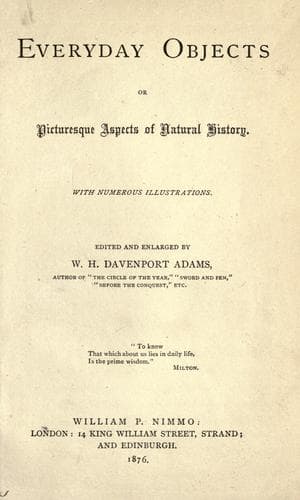
Everyday Objects; Or, Picturesque Aspects of Natural History.Adams, W. H. Davenport (William Henry Davenport)
History
Everyday Objects; Or, Picturesque Aspects of Natural History.
Adams, W. H. Davenport (William Henry Davenport)
Natural history
The method to be adopted has been indicated by Alexander von Humboldt
in his "Ansichten der Natur" ("Pictures of Nature"). His method
consists in the comparison of the vegetable families whose numerical
relations are _known_, with the number of species contained in our
herbariums, or cultivated in our botanical gardens.
But here, at the outset, a difficulty confronts us. Does any relation
exist between the classification of plants by natural families and by
their geographical distribution?
To group plants according to their analogies of structure, we study
them from an abstract point of view, and without any regard to the
medium in which they flourish. The question grows complicated if we
also take into consideration their characteristic conditions and
their distribution over the terrestrial surface. Families are then
split asunder, and the importance of our scientific classifications
disappears.
The gathering together of a small number of species, represented by
innumerable individuals, confined within the same area, may suffice
to communicate to a landscape its characteristic physiognomy: as,
for example, is the case with the Asiatic steppes, the _landes_ of
Brittany, the moors of Scotland, the palm-groves and the clumps of
Cactaceæ of tropical America. By the side of species which impress us
by their _mass_--that is, by the frequent reproduction of the same
individuals at an infinitesimal distance from one another--are placed
those much more numerous species which are everywhere very thinly
sown.
But do the plants themselves follow, from the equator to the poles,
the same law of _decrease_ as obtains from the base to the summit of
the loftiest equatorial mountains?
Under identical isothermal lines, is the ratio of families known and
identified to the probable aggregate of Phanerogams the same, in the
temperate zone, on either side of the equator?
What are the vegetable families which preponderate at the two
extremes, represented by the torrid and the frigid zones?
Under the same geographical latitude, or between the same isothermal
lines, are the Synantheræ, the Gramineæ, the Leguminosæ, the Labiatæ,
the Cruciferæ, the Umbelliferæ, more numerous in the Old than in the
New World?
What families, either through their mass of individuals or their
number of species, take precedence of the other Phanerogams?
How many species of one and the same family belong to any particular
country?
What groups or families are characteristic of each zone?
Is the present classification of genera and species in all respects
what could be desired?
* * * * *
These are questions that require to be considered, and to some of
them we shall presently attempt replies.
Public-domain text, read in full here on John Shaqi.
Reviews
Reviews
No reviews yet
Be the first to share your thoughts on this work.
Elsewhere in the archive
Join the Discussion
Join the discussion
Sign in to leave a comment or review.
Sign InorCreate an account