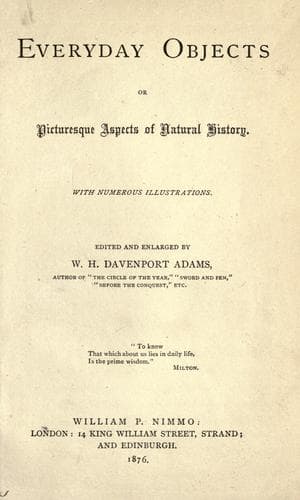
Everyday Objects; Or, Picturesque Aspects of Natural History.Adams, W. H. Davenport (William Henry Davenport)
History
Everyday Objects; Or, Picturesque Aspects of Natural History.
Adams, W. H. Davenport (William Henry Davenport)
Natural history
"The juice of the soapwort," says Miss Pratt, "is one of those
vegetable substances which, by making a lather with water, will
cleanse linen, and remove grease as effectually as soap. It grows
more generally in the neighbourhood of villages than in any other
situation, as if providence had placed it there especially for
the service of the cottager; yet it is very little used, either
from ignorance of its properties, or because it would require
some cultivation to render it sufficiently plentiful for household
purposes. It needs the addition of ashes to make it a good soap
for washing linen; but it is of much service to the shepherds on
the Alps, who wash their flocks, previously to shearing them, with
soapsuds made by boiling this plant in water. The large fruit of the
horse-chestnut has similar cleansing properties, and may be used by
cutting it into small pieces, or scraping it into water. It has even
been suggested that if the nuts were reduced to powder, and made
into balls, with some unctuous substance, they would answer all the
purposes of our manufactured soap; and yet numbers of poor people see
these nuts lying decaying in their neighbourhood, and have no idea of
making them of any service."
On the Continent, however, the peasantry are wiser, and not
only provide themselves with chestnuts for soap, but gather the
beech-leaves to stuff their mattresses.
Returning to the Caryophyllaceæ, we may add that some of the
plants of this order have poisonous qualities, which are due to
the principle called _saponine_ existing in many of the species of
Saponaria, Silene, Lychnis, and Dianthus.
According to Lindley, the order includes no less than 53 genera, and
1055 species. They inhabit chiefly temperate and cold regions, and
are ranked in three sub-orders,--Alsineæ, Sileneæ, and Mollugineæ.
THE EGLANTINE AND THE CONVOLVULUS.
What plant do our poets mean by the eglantine? What by the woodbine?
Are they one and the same, or are they different?
We cannot answer those questions until we have referred to three or
four passages in which they are introduced. And, first, let us take
an example from Spenser:--
"And over him, art striving to compare
With nature, did an arbour green dispread,
Framèd of wanton ivy, flowering fair,
Through which the fragrant eglantine did spread
His pricking arms, entrailed with roses red,
Which dainty odours round about them threw,
And all within with flowers was garnishèd,
That when wild Zephyrus amongst them blew,
Did breathe out bounteous smells, and painted colours shew."
And now from Milton:--
"Through the sweetbriar, or the vine,
Or the twisted eglantine."
The following is from Sir Walter Scott:--
"On the hill
Let the white heath-bell flourish still,
Cherish the tulip, prune the vine,
But freely let the woodbine twine,
And leave untrimmed the eglantine."
From Burns:--
Public-domain text, read in full here on John Shaqi.
Reviews
Reviews
No reviews yet
Be the first to share your thoughts on this work.
Elsewhere in the archive
Join the Discussion
Join the discussion
Sign in to leave a comment or review.
Sign InorCreate an account