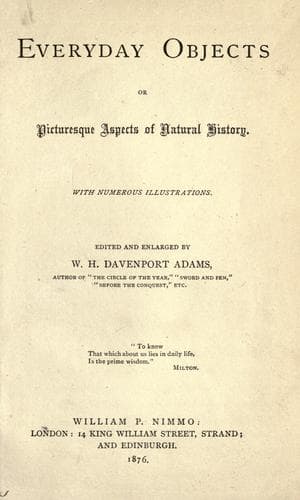
Everyday Objects; Or, Picturesque Aspects of Natural History.Adams, W. H. Davenport (William Henry Davenport)
History
Everyday Objects; Or, Picturesque Aspects of Natural History.
Adams, W. H. Davenport (William Henry Davenport)
Natural history
"The woodbine I will pu' when the evening star is near,
And the diamond draps of dew shall be her een sae clear."
From Michael Drayton:--
"The azured harebell next with them they neatly mixt:
T' allay whose luscious smell they woodbine placed betwixt ...
The columbine amongst they sparingly do set,
And now and then among, of eglantine a spray."
And lastly, from Shakespeare:--
"And leaf of eglantine, whom not to slander,
Out-sweetened not thy breath."
There is evidently some confusion here, and the eglantine of one poet
is not the eglantine of another. Sir Walter Scott, we take it, is
thinking of the wild clematis or virgin's bower, when he wishes the
eglantine to remain untrimmed. And Milton undoubtedly refers to the
honeysuckle, which, twisting round the framework of a cottage-porch,
tempts the neighbouring bees to rifle its calyxes of their honeyed
sweets. But the _true_ eglantine of our earlier poets seems to have
been the prickly sweetbriar, formerly called _Rosa eglantina_; now
known as _Rosa rubiginosa_. No plant is of greater value for a garden
hedge, owing to the delicious fragrance exhaled not only by its
flowers but by its leaves.
On the other hand, the "lush woodbine," which so often finds
honourable mention in our poets, is none other than the honeysuckle,
the "twisted eglantine" of Milton. Its botanical name is
_Caprifolium_.
The eglantine and the woodbine, therefore, though occasionally
confounded by careless writers, are two entirely distinct plants; the
former being the sweetbriar of modern gardens, and the latter the
honeysuckle.
[Illustration: FIG. 81.--"Our leafy hedgerows."]
It has been justly said by a writer (whom we have already quoted),
that of all the flowers which, towards the end of summer and the
beginning of autumn, adorn our pastoral scenery, "filling the air
with fragrance, and the earth with beauty," none are more generally
attractive than the wild climbing plants of our leafy hedgerows.
By interlacing their delicate boughs, covered with foliage and
flowers,--or with berries bright and sparkling,--or, as in the wild
clematis, crowned with the lightest, feathery seeds,--they wind
about the trees and bushes in festoons and wreaths of the utmost
elegance,--and contribute in no slight degree to the aspect of
richness and beauty which the landscape exhibits at this time of the
year. As their stems are so slender and delicate that they would be
crushed by the burthen of their flowery clusters and numerous leaves,
or rent and uprooted by the wind, unless they found support from
other plants, we see them hanging by their tendrils, or by their
pliant arms, about the trunks of aged trees,--the ancestral elms,
or "those green-robed senators of mighty woods, tall oaks,"--like a
frail maiden to the sturdy arm of some strong-shouldered brother, or,
it may be, of some one "nearer and dearer still."
In reference to those climbing plants, one curious circumstance
deserves to be noted.
Public-domain text, read in full here on John Shaqi.
Reviews
Reviews
No reviews yet
Be the first to share your thoughts on this work.
Elsewhere in the archive
Join the Discussion
Join the discussion
Sign in to leave a comment or review.
Sign InorCreate an account