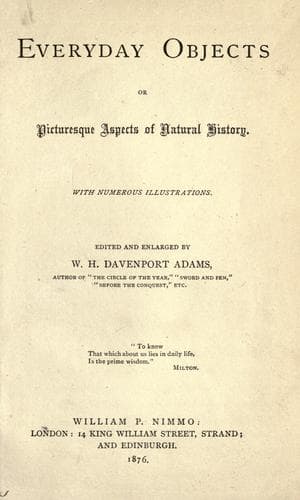
Everyday Objects; Or, Picturesque Aspects of Natural History.Adams, W. H. Davenport (William Henry Davenport)
History
Everyday Objects; Or, Picturesque Aspects of Natural History.
Adams, W. H. Davenport (William Henry Davenport)
Natural history
But even the said pebbly bed, like the hardest rock, like the
seemingly everlasting granite, must and does change. The compact,
chrystalline, azoic rock, without a trace of life in its dense mass,
would eventually decompose if constantly assailed and affected by
the moving waves of that gaseous ocean whose bed is formed by the
terrestrial crust. If the rock is found covered by more or less
stratified layers, its presence in the bosom of the earth will
attest to passing generations the primordial incandescence of our
planet at some epoch when life as yet was _not_,--when the liquid
element, hurled far away into space under the form of vapour,
exhibited the aspect of a "bearded meteor," or a comet, with blazing
nucleus and incandescent tail. Many the changes which since that
distant epoch have taken place upon the earth, and many more must
occur before our planet ceases to contribute its strain to the grand
harmony of the spheres. Our world will _end_ as surely as it once
had a beginning: its duration, though it be computed by hundreds of
thousands of years, is nothing, will be nothing, compared with that
of the revolution of yonder sun, circling, with its wondrous train of
planets, around some mysterious centre as yet unknown. And in this
period, hitherto incalculable, what chances of perturbation will
necessarily arise?
Let us suppose that the centre around which oscillates, on the one
part, the moon while drawing near and receding from the earth; on the
other, the earth while drawing near and receding from the sun: let
us suppose that these centres oscillate in the same manner around
other centres as yet undetermined,--and this hypothesis is very
rational, since it is based on the principle that everything moves
or changes,--it may happen that in these periodical oscillations,
one or more of the circulating masses will eventually fall into
their focus of attraction, or will start so widely astray that the
wheelwork of our world, the various parts of our planetary system,
will separate,--not to be annihilated, for nothing in the universe
can be _annihilated_,--but to be metamorphosed, and group themselves
elsewhere in a different order.[87]
It is thus that in chemistry, which I would call the _astronomy of
atoms_, it is shown that bodies are only so far decomposed as to
admit of their recombination in new forms; the end of one is the
beginning of another.
Now, that which is true of the systems of the elementary bodies
composing terrestrial matter, is, in all probability, true also--why
should it not be?--of the systems of the celestial bodies.
Public-domain text, read in full here on John Shaqi.
Reviews
Reviews
No reviews yet
Be the first to share your thoughts on this work.
Elsewhere in the archive
Join the Discussion
Join the discussion
Sign in to leave a comment or review.
Sign InorCreate an account