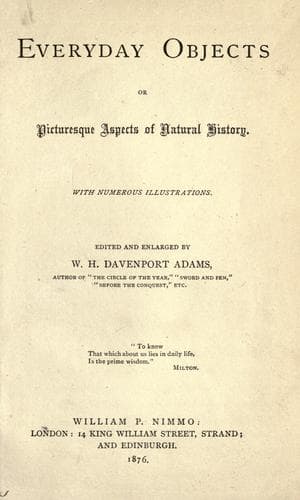
Everyday Objects; Or, Picturesque Aspects of Natural History.Adams, W. H. Davenport (William Henry Davenport)
History
Everyday Objects; Or, Picturesque Aspects of Natural History.
Adams, W. H. Davenport (William Henry Davenport)
Natural history
Differences of magnitude, of space, and of time, which overwhelm
our feeble imaginations, vanish before the unity of plan of the
Creator's thought. A crystalline molecule, which will not affect
the finest balance, is a world, with an equator and poles of its
own, and its central atom round which atomic satellites gravitate.
Whether these atoms are infinitely small or infinitely great,
whether the time of their revolutions is measured by thousandths
of a second or by myriads of years, is of little importance so far
as their gravitation (_ponderation_, or _poising_) is concerned.
For this ponderation is absolutely identical, whether we call it
_affinity_,--when speaking of the atomic movements of chemically
decomposable matter; or _gravitation_ or _attraction_, when referring
to those atoms of the great whole which we call stars, and whose
metamorphic scale is far beyond the range of beings planted on the
surface of one of the stellar atoms. However profound may be the
researches of our astronomers, they will never attain to a knowledge
of the metamorphoses of worlds. The spectacle of celestial spheres
rising anew from their ashes, like "the Arabian bird" of fable, will
be as impossible for them as the knowledge of the decompositions and
recompositions of our material bodies would be for chemists, planted
on the surface of an atom of carbon. How, from such a standpoint,
could they contemplate the manifold forms of matter, and embrace at
a glance all its changes?... Well, we are relatively as powerless as
these imaginary denizens of an atom of matter, rooted as we are to
the crust of a planet,--a molecule suspended in the eternal ocean.
What shall we now say of the forms and movements of _living matter_?
In the first place, that they are infinitely more varied and more
changeful than those of inanimate nature. Next, that the difference
between their metamorphoses is very wide. The eye can follow the
transformations of a rock exposed to the decomposing action of the
agents which surround us on every side. This action is calculable,
and the elements which it has dissociated may be determined and
weighed. The effects of the force, called either affinity or
attraction, which maintains these elements united, are not beyond the
range of our observation; tables of affinity, and of atomic weights,
have been constructed, which enable the chemist to dominate over
matter, just as the astronomer embraces the stars, the atoms of the
world, by the law of universal gravitation.
Public-domain text, read in full here on John Shaqi.
Reviews
Reviews
No reviews yet
Be the first to share your thoughts on this work.
Elsewhere in the archive
Join the Discussion
Join the discussion
Sign in to leave a comment or review.
Sign InorCreate an account