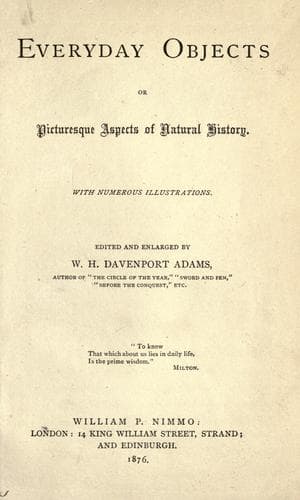
Everyday Objects; Or, Picturesque Aspects of Natural History.Adams, W. H. Davenport (William Henry Davenport)
History
Everyday Objects; Or, Picturesque Aspects of Natural History.
Adams, W. H. Davenport (William Henry Davenport)
Natural history
Thus it is that the collective integral being which we call humanity,
lives and is developed through the removal of the individuals
composing it,--ephemeral creatures, each of whom thinks himself a god!
Must we stop there? That would be to declare humanity the last
term of a progression whose commencement and end, according to our
own acknowledgment, completely escape us: it would be at once a
contradiction and a flagrant violation of the great law of infinite
continuity which reigns everywhere.
* * * * *
To suppose that beyond humanity there is only nothingness, would be
to enunciate an hypothesis as puerile as that which pretended the
earth was not only the centre of our system, but the sole inhabited
or inhabitable point in the immensity of space, and that the stars
of the firmament were created for the service and pleasure of
mortals. Suppose that this absurd belief were true; of what use, I
ask you, would be all our agitations, all our flutterings, all our
conceptions, all our conquests, all our glories, all our memories,
when the end of the world would sweep away and annihilate our race?
It was well worth the trouble, truly, of being born, of living, and
of suffering, to terminate, after all, in so inglorious a fashion!...
Adhere to your hypothesis, materialist, if you have the courage;
surely, no man of sense can accept it!
* * * * *
Let us now resume the thread of our meditations.
The end of our system has come at last: the sun, the planets, and
their satellites form but one chaotic igneous mass,--a brilliant
fugitive luminary, new-born to the inhabitants of worlds which have
escaped intact.
The dust of our extinguished world will not be scattered hap-hazard;
the molecules of matter, indissolubly linked together by universal
gravitation, will so arrange themselves as to constitute a new, and
perhaps a more perfect world. But in the constitution of this new
world, balanced like the old, our human bones, our ashes united
with those of our ancestors, may have, as far as they are matter,
their due share. As for the Thought which makes the true power of
humanity, which gives to man all his value,--Thought, perfectible and
transmissible,--it will contribute nothing, because it is absolutely
imponderable and impassible. Will it then be lost for ever?
If the world is to last for ever, you may justly regard as immortal
the indefinite transmission of Thought, and the perpetuity of the
memory of certain great men. But will all this avail, if the world
must perish?
The world will never end, you say; it is eternal.
Public-domain text, read in full here on John Shaqi.
Reviews
Reviews
No reviews yet
Be the first to share your thoughts on this work.
Elsewhere in the archive
Join the Discussion
Join the discussion
Sign in to leave a comment or review.
Sign InorCreate an account