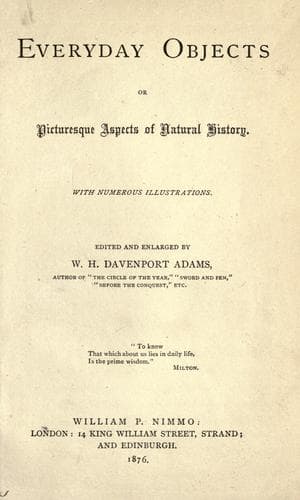
Everyday Objects; Or, Picturesque Aspects of Natural History.Adams, W. H. Davenport (William Henry Davenport)
History
Everyday Objects; Or, Picturesque Aspects of Natural History.
Adams, W. H. Davenport (William Henry Davenport)
Natural history
But how do you know this? If it has had a beginning, as geology and
astronomy prove,[90] it will also have an end. This end, however,
will not be an annihilation; it will simply be, as we have already
pointed out, a transformation of matter. As for the problems, whether
nature itself was created, and whether it is eternal, let us leave
them to the discussion of heated theoricians, who are too blind to
perceive that some questions it is wisest neither to affirm nor deny,
but _to know how to ignore_.
* * * * *
The error, then, which we have been considering, destroys itself
through its consequences. Let us admit, in effect, that our
world--such as it is, just as it is--will last for ever. In that case
what becomes of the power and travail of humanity? All they have
accomplished are some slight changes of the terrestrial crust, barely
sufficient, here and there, to modify the influences of climate.
A limited number of men labour, it is true, for the progress and
full development of transmissible thought. But even supposing that,
in the course of centuries, humanity succeeds in comprehending, it
can only _grow_ through the development of the faculties of all its
members, and the due balance of all the social forces by means of
liberty. Supposing that reason, united to science and conscience,
should finally combine in one family the various tribes and peoples
scattered over the earth's broad surface; do you indulge yourself
in the hope of crossing the limits of the human organization, and
establishing the royalty of man "through the interpretation and
imitation of Nature?"
Do you cherish the idea of penetrating, through the perfect union of
all your intellectual forces, the mysteries of creation?
No; you would never dare to form such a hope, to nourish such an
idea, at least unless you felt that the earth (which you must
first demonstrate) comprehends in itself the whole universe, that
the humanity swarming on its surface is eternal, that every other
creature is absolutely subordinate to it: in a word, that Man is all!
But we know how limited is human power. We are not masters even
of the mechanism of the body; the movements of organic life are
independent of our will; we can neither command the stomach, the
lungs, nor the heart: that marvellous process of absorption and
elimination, that perpetual movement hither or thither which
constitutes the essence of the assimilative function, goes on in
us--as in all living beings, animal or vegetable--completely outside
our sphere of activity. Then, without quitting our planet, how
numerous are the movements which still escape the human will!
* * * * *
Public-domain text, read in full here on John Shaqi.
Reviews
Reviews
No reviews yet
Be the first to share your thoughts on this work.
Elsewhere in the archive
Join the Discussion
Join the discussion
Sign in to leave a comment or review.
Sign InorCreate an account