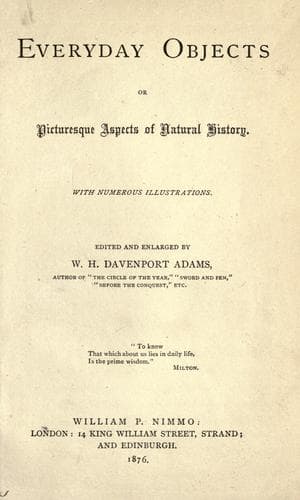
Everyday Objects; Or, Picturesque Aspects of Natural History.Adams, W. H. Davenport (William Henry Davenport)
History
Everyday Objects; Or, Picturesque Aspects of Natural History.
Adams, W. H. Davenport (William Henry Davenport)
Natural history
Malpighi, the botanist, his theory of the rise of sap, 135.
Mammalia, the, summarised, 360.
Manilius, the poet, his references to the Great Bear, quoted, 20, 21.
Mant, Bishop, quoted, 63, 64.
Mariotte, the botanist, his theory of the rise of sap, 135.
Marmot, the, described, 53;
its habits, 53, 54;
the various species of, 55.
Mars, the planet, referred to, 301, 302.
Marsupialia, the, distribution of, 358.
Martins, M., the naturalist, his examination and description of
the Arctic vole, 51, 52.
Marvell, Andrew, the poet, quoted, 217.
Matter, forms of living, 388, 389.
_Mercurialis annua._ _See_ DOG MERCURY.
Metamorphosis, the function of, in nature, 401, 402.
Milton, his allusion to the daisy, quoted, 151, 152.
Mole, the, peculiar movements of, 265, 266;
described, 267;
Aristotle and Pliny on its want of sight, 267;
its hands and fingers, 268;
its favourite haunts, 269;
marvellous properties ascribed to, 270, 271.
Mole-cricket, the, its form and habits described, 273-278.
Mollusca, the, number of species of, 362.
Moon, influence of, on the weather, 30, 31.
Moore, Thomas, the poet, his characterisation of the dragon-fly, 174;
his allusion to the water-lily of the East, 246.
Mountain pink, the, described, 374, 375.
Mushroom, the, how to be distinguished, 327, 328;
some varieties of, described, 329-337.
Mutability, the lesson of, 316.
_Myosotis palustris._ _See_ FORGET-ME-NOT.
Nature, beauty and suggestiveness of, 339;
our imperfect knowledge of, 341, 342;
the infinite diversity of, 365.
_Nebria escheri_ described, 72;
_chevrierii_, 72.
Newman, Mr, author of "History of British Insects," quoted, 285.
Newton, Sir Isaac, his theories as to the form of the earth, 111, 112.
_Nuphar lutea_, the, described, 245.
Nutation of the earth, the, explained, 120, 121, 123;
its discovery, 121, 122.
Observer, the, of nature, 4, 5.
_Œnothera biennis_, described, 216, 218, 219.
Orion, the occultation of, its position in the heavens, 14;
its place in the old mythology, 15.
Pachydermata, the, distribution of, 359.
Parry, Captain, on the nature of red snow, 41.
Perianth, the, of flowers, 208.
Perrault, the botanist, his theory of the rise of sap, 135.
Petals, the, of flowers, described, 109, 224-227.
Phœnicians, the, their knowledge of the Great and Little Bears,
20, 21.
_Physalis alkekengi_, described, 222.
Pilgran, the meteorologist, his researches into the nature of
climate, 31.
Pimpernel, the, all about, 260-264.
Pinks, the various kinds of, described, 374.
Planets, the, whether inhabited, 395.
Plants, discovery of the sex of, 207;
appropriate to certain soils, 320, 321;
diffusion of, 321-325;
classification of, 343-345.
Public-domain text, read in full here on John Shaqi.
Reviews
Reviews
No reviews yet
Be the first to share your thoughts on this work.
Elsewhere in the archive
Join the Discussion
Join the discussion
Sign in to leave a comment or review.
Sign InorCreate an account