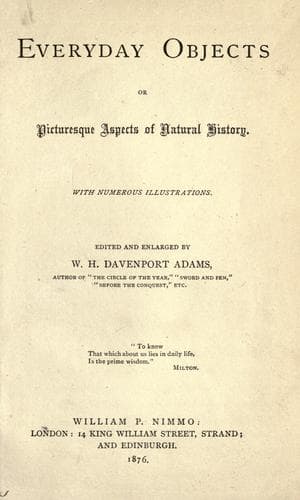
Everyday Objects; Or, Picturesque Aspects of Natural History.Adams, W. H. Davenport (William Henry Davenport)
History
Everyday Objects; Or, Picturesque Aspects of Natural History.
Adams, W. H. Davenport (William Henry Davenport)
Natural history
Plato, the philosopher, his notion of the form of the globe, 105, 106.
Pliny, the naturalist, on numbering the stars, 25;
his reference to red snow, 39;
and to the mercurialis, 80, 81;
on the gramen, 94, 95;
his reference to the daisy, 146;
on the mole, 270, 271.
Plutarch, the historian, on the probability of the existence of the
antipodes, 108.
_Podura plumbea_, the, described, 74, 75.
Polar Star, the, its position in the heavens, 18.
Poles, day at the, 200, 201.
_Polygala vulgaris_, the, described, 213.
Pointers, constellation of the, referred to, 22.
Pratt, Miss, on the forget-me-not, 238.
Proctor, R. A., on solar phenomena, 410, 411.
_Protococcus nivalis_, the plant described, 42-44.
Prunella, the, or "self-heal," described, 230-233.
Ptolemæus, his enumeration of the constellations, 24;
his acquaintance with the so-called Copernican theory, 119;
astronomical theories of, 297, 298.
Pythagoras, the philosopher, his familiarity with the so-called
Copernican theory, 119.
Quadrumana, the, distribution of, 357, 358.
Ramond, the naturalist, his researches in the natural history of
red snow, 40, 41.
Ranunculaceæ, the, general characteristics of, 166-169.
Ray, the botanist, on the daisy, 146.
Red-billed crow, the, its appearance described, 68, 69;
its habits, 69;
the history of one which had been tamed, 69, 70.
Red snow, known to Pliny, the naturalist, 39;
first described scientifically by De Saussure, 39, 40;
discovered by Ramond in the Pyrenees, 40;
by Captain Ross in Baffin's Bay, 41;
described by Sir John Ross, 41;
a fungus (?) 41.
Reptiles, the, distribution of, 361.
Rhizomes, or trailing roots, referred to, 88, 89.
Rhodius, Apollonius, the poet, quoted, 20.
Rodentia, the, distribution of, 358.
Rogers, the poet, quoted, 403.
Ruminantia, the, how distributed, 358.
Salamanca, the council of, referred to, 108.
Sap, the circulation of, 132;
its ascent and descent, 133;
theories concerning the rise of, 134-137.
Saussure, Benedict de, the naturalist, his observations on red snow,
39, 40.
Science, unselfishness of, 76;
the peculiar characteristics of, 133.
Scutellariæ, the, characteristics of, indicated, 235, 236.
Seasons, the, changes of, 204, 205.
Seneca, the philosopher, his conception of the earth's support in
space, 104.
Shakespeare, his allusions to the daisy, quoted, 150, 151;
the lily described by, 242.
Shelley, the poet, quoted, 152.
Sirius, the star, its colour, 26;
deleterious influence ascribed to, by the Greeks, 23, 24.
Public-domain text, read in full here on John Shaqi.
Reviews
Reviews
No reviews yet
Be the first to share your thoughts on this work.
Elsewhere in the archive
Join the Discussion
Join the discussion
Sign in to leave a comment or review.
Sign InorCreate an account