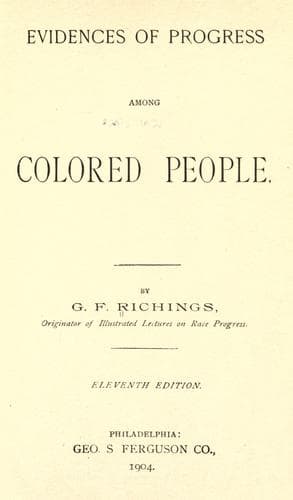
Evidences of Progress Among Colored PeopleRichings, G. F.
History
Evidences of Progress Among Colored People
Richings, G. F.
African Americans
"INSTITUTE FOR COLORED YOUTH."
Philadelphia is known for her facilities for education. Few American
cities are better equipped with schools, public and private--free
schools and those in which tuition fees are demanded--schools devoted
to languages, schools devoted to art. In short, everything that one
might desire as a means for obtaining an education in any known branch
is provided for the student, and the road to knowledge is made about as
easy as it can possibly be made.
But of all the schools provided for the instruction of children, youths
and adults, none is of greater importance, perhaps, than that known as
the "_Institute for Colored Youth_." Strange to say, it had its origin
in the kindly forethought of one who had once been a slave-holder.
In the year 1832 Richard Humphreys, a native of the West Indies, but
at that time a citizen of Philadelphia, died, leaving $10,000 to
found an institution, "having," as he worded it, "for its object the
benevolent design of instructing the descendants of the African race
in school-learning, in the various branches of the mechanic arts and
trades, and in agriculture, in order to prepare, fit and qualify them
to act as teachers."
This sum was left with the Society of Friends (of which sect he was a
member), with the provision that this society should have the care of
the institution. In accordance with this bequest and stipulation, in
1837 the "Institute" was founded, the sum of money left for the purpose
amounting at this time, through careful investment, to about $13,300.
The charter was not obtained from the State of Pennsylvania until 1842.
Shortly after this the sum of $18,000 was left by another Friend for
educational purposes, which was given to further the interests of the
Institute.
From time to time, different sums were bequeathed and bestowed for
this enterprise by philanthropic people until, in 1851, buildings were
erected on Lombard street for the permanent establishment of this
institution of learning, in which location it remained until 1866. At
that time it had become clearly evident that the enterprise had reached
such proportions that more ample and convenient accommodations were
urgently required. A movement, therefore, was set on foot to accomplish
the work, if possible, and a sufficient number of interested friends
were found to erect the large and commodious building now situated on
Bainbridge street, above Ninth, at a cost of $40,000, including the
ground.
Public-domain text, read in full here on John Shaqi.
Reviews
Reviews
No reviews yet
Be the first to share your thoughts on this work.
Elsewhere in the archive
Join the Discussion
Join the discussion
Sign in to leave a comment or review.
Sign InorCreate an account