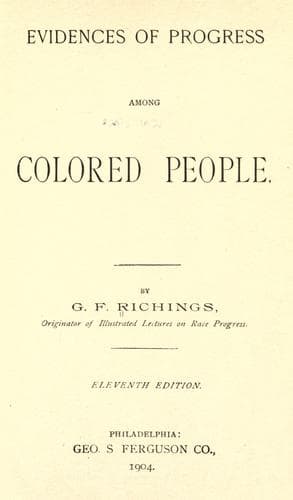
Evidences of Progress Among Colored PeopleRichings, G. F.
History
Evidences of Progress Among Colored People
Richings, G. F.
African Americans
For competent teachers, earnest men and women who are doing a noble
work for the elevation of the race, there are not, to my knowledge,
to be found anywhere in the United States a larger number than in
Washington, D. C.
One feature of the school work of Washington is the industrial
departments of the public schools.
I am endebted to Prof. G. F. T. Cook for these splendid observations,
and during my visit to Washington he told me much more that would make
not only interesting reading, but valuable study to those who are
seeking the truth as regards the educational forces in operation in
Washington for the improvement of the colored citizens. The noble work
of Prof. Cook is aided by the following persons who are supervising
principals: H. P. Montgomery, W. S. Montgomery, J. H. N. Waring, F. L.
Cardoso, Miss L. E. Moten, H. F. Grant, T. W. Hunster, J. H. Hill, Mrs.
M. B. Cook, Mrs. C. E. Syphax, Mrs. M. P. Evans.
I want to say in this connection, that Mrs. Mary C. Terrell is one of
the Board of Trustees of Public Schools for the District of Columbia,
and she is the first colored lady to be so honored in any city in the
United States to my knowledge. I present her portrait.
Mrs. Terrell is interested in every movement that will advance the
cause of colored people and especially colored women. I am told
that she has just been elected as President of the Federation of
Afro-American Women, and succeeds Mrs. Booker T. Washington, who was
the first president.
She is a graduate of Oberlin College, Ohio, and was at one time a
teacher at Wilberforce University, Ohio, where she was much loved.
CHAPTER XV.
NASHVILLE, TENN.
Under this heading I shall call attention to the advance made by
the colored people of this great city. Nashville certainly has all
the essentials of a great city; it has a rich tributary country, a
healthful climate, river and rail transportation, proximity of abundant
raw material, and a sturdy, healthy industrious population.
Having all of these then, Nashville, the capital of Tennessee, situated
in the centre of a realm unequalled in variety and amount of production
on the American continent, with 100,000 people largely native to the
soil through long generations, is assuredly a great city.
It has been just thirty-one years since the war closed. Nashville then
contained a scant 25,000 people. Ten years later her population was
40,000. In 1885 it was 60,000, and to-day within her borders there are
more than 100,000 souls. No better evidence of the advance and the
prosperity of the city than that could be given.
And through this entire history, the colored people have figured
conspicuously during every step of her progress.
Public-domain text, read in full here on John Shaqi.
Reviews
Reviews
No reviews yet
Be the first to share your thoughts on this work.
Elsewhere in the archive
Join the Discussion
Join the discussion
Sign in to leave a comment or review.
Sign InorCreate an account