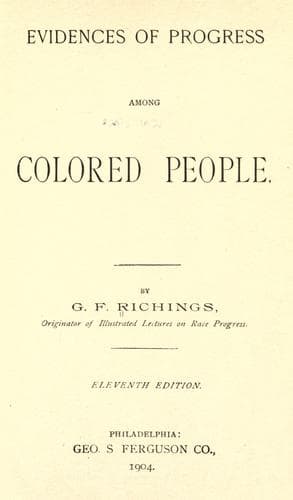
Evidences of Progress Among Colored PeopleRichings, G. F.
History
Evidences of Progress Among Colored People
Richings, G. F.
African Americans
The design is to establish a first-class Normal School with an
Industrial Department.
More lands are needed, and can be secured. The academy has a charter
from the State Legislature, by which the school is opened to all of
good moral character--colored or white.
Practically, at present, the school is colored. The buildings are
adjacent to the village of Camp Nelson, composed of colored citizens
who settled there immediately after the war.
Of the forty-four families in the village, forty-two have their own
homesteads.
The village has a charter from the State Legislature and no
intoxicating liquors are sold in it.
The situation is central, high, and beautiful. In the county of
Jessimine and the five counties adjacent there are over forty thousand
colored people. These with Christian culture and skilled labor could be
a great power for social well-being in that centre of the State.
Who will help uplift and save?
Mr. John G. Fee is President of the Board of Trustees of Camp Nelson
Academy, and much could be said about him that would be of interest to
the public. Few men have suffered more for the colored people than Mr.
Fee, not only in a social way, but he has suffered from mob-violence
because of the stand he took in favor of the race in their educational
interest and their rights as American citizens.
SCHOOL WORK IN WASHINGTON, D. C.
On my first visit to Washington, D. C., in 1892, I took advantage of
the opportunity offered me to study the school question in that city.
I shall ever feel grateful to Prof. G. F. T. Cook, for the kindness
shown me, in giving me useful information on that subject. Those who
regard the colored man incapable of looking after his own educational
interests, need only visit the public schools of Washington to have
his views very much changed. In the high school I found the greatest
interest. That building is under the control of Prof. F. L. Cardoso,
who has been for years a very useful man in the educational interest of
the race. He received a fine University training in Glasgow, Scotland,
before the war, and afterwards, I think, secured a scholarship at
Oxford. In the early days of freedom, he founded in the interest of the
A. M. A. Society what is known as Avery Institute, Charleston, S. C., a
school that has done grand work for the race.
At the High School, I met Mr. Hugh Brown, who is beyond doubt one
of the finest scholars in America, white or colored. He called my
attention to a phase of Negro education I knew nothing of. In the
department of Elementary Physics, he showed me a first-class telephone,
made entirely by colored students; the phone was then in use. I saw in
print a statement from Mr. Bell, of the Bell Telephone Co., in which
he said, "I regard this telephone, made entirely by these students,
as good as any I have ever tested." Mr. Brown also showed me quite a
number of electrical appliances, all made by students.
[Illustration: MRS. MARY C. TERRELL.]
Public-domain text, read in full here on John Shaqi.
Reviews
Reviews
No reviews yet
Be the first to share your thoughts on this work.
Elsewhere in the archive
Join the Discussion
Join the discussion
Sign in to leave a comment or review.
Sign InorCreate an account