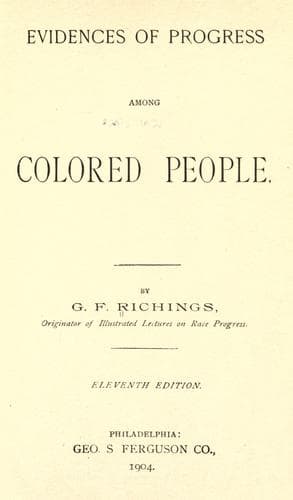
Evidences of Progress Among Colored PeopleRichings, G. F.
History
Evidences of Progress Among Colored People
Richings, G. F.
African Americans
Mr. G. M. Howell, a young man, does quite a good business as a merchant
tailor in one of the rooms under the Kimble House. I can speak for Mr.
Howell's workmanship as a tailor from the fact that I have had work
done by him. I think a large portion of his patronage comes from white
people.
Mrs. M. A. Pennamone, of Atlanta, does quite a business as a milliner,
and strange to say most of her customers are white people. I have
often wondered why there were not more colored women in the millinery
business.
In addition to those already mentioned from Atlanta, there are many
engaged in various walks of life, such as conducting wood yards, coal
yards, draying and doing just what white people do who want to earn
an honest living. Atlanta has six educational institutions, to say
nothing of the city or public schools, in which there are employed some
seventy-five colored teachers. I have been told by the better class
of white men in the South, that "colored people own far more property
and are getting along much better than the middle and lower classes
of the whites." I have heard it said that the only progress being
made by colored people in this country was in the South. I am indeed
willing to give the South credit for its wonderful development, but as
a friend to the race in all parts of the country, I must say that the
colored people are also making progress in the North. True, many of
our successful men in the North came from the South; but they built up
their business in the North.
I met while in Indianapolis, Ind., some very successful people in the
persons of the following gentlemen:
Capt. J. Porter is employed as a bank clerk in a white bank. He is the
only colored man I have met holding just such a position. The men at
the head of the bank regard him as a very reliable and competent man.
The late Benjamin Thornton, of Indianapolis, established for himself
a great reputation as a first-class detective. He stood alone in this
respect as a colored man. He has often been sent for to work up large
cases in some of our leading cities where large amounts of money and
jewels have been stolen. Mr. Thornton was quite a public-spirited man,
and has done a great deal to help others secure homes, and well thought
of by both white and colored.
The city can boast of two magnificent barber shops owned by colored
men. One at the Hotel Dennison is owned by Messrs. Moore and Lanear,
costing about $6,000. The other one is owned by Geo. L. Knox at the
Bates House. Some twenty men are employed there, and several ladies in
the ladies' hairdressing department. This shop is said to have cost
$10,000. Mr. Knox is also the publisher of the _Freeman_, which is
mentioned in another part of my book.
Mr. Baptist, of Indianapolis, is a very successful contractor, and in
1893 built for John C. New a $10,000 residence. There were quite a
number of white contractors competing for the work.
Public-domain text, read in full here on John Shaqi.
Reviews
Reviews
No reviews yet
Be the first to share your thoughts on this work.
Elsewhere in the archive
Join the Discussion
Join the discussion
Sign in to leave a comment or review.
Sign InorCreate an account