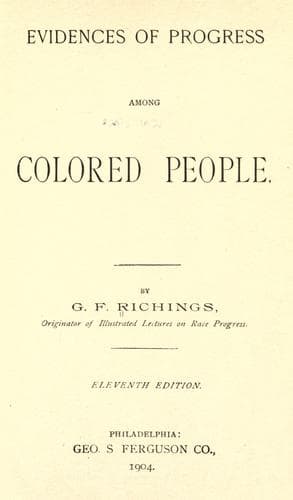
Evidences of Progress Among Colored PeopleRichings, G. F.
History
Evidences of Progress Among Colored People
Richings, G. F.
African Americans
In 1868 Hon. John M. Langston, then Dean of the Law School of Howard
University, was engaged in lecturing through the South, upon the
advantages of said institute to the colored race, and the opportunity
afforded to receive a professional education therein. Mr. Straker
attended one of such lectures, and was attracted to the University.
He gave up his theological studies and returned to his first love,
entering Howard University Law School as a law student in 1869,
in a class six months advanced. He graduated in 1871, with honor
and distinction, and at Commencement delivered an address on "The
Necessity for a Common Tribunal Among Nations for the Arbitration of
International Disputes." His views then are greatly verified as to the
necessity of such a tribunal, by the experiences of the present day.
His learning in the law and masterly discussion of the subject secured
him the praise and commendation of the scholar and statesman, Hon.
Charles Sumner, of Massachusetts.
While studying law, he secured a clerkship in the Sixth Auditor's
office of the U. S. Treasury, in which post he remained until 1875. In
1871 he was married in Detroit, Mich., to Miss Annie M. Carey, his
present wife, with whom he now lives, having had no children born to
them.
In 1875, he resigned his position in the Treasury Department, and went
to South Carolina as Inspector of Customs, at Charleston.
In 1876, he resigned said post, and began the practice of his
profession in the town of Orangeburg, S. C., and soon was recognized as
a capable criminal lawyer by his white brethren at that bar, and the
community in general. In the fall season of said year, he was elected
to the General Assembly of that State, and took his seat in the famous
House, well known as the Hampton-Mackey dual Legislature, by which
Governor Chamberlain, the duly elected Governor of the State, was
driven from his post. Mr. Straker was not long a member, because of his
eviction with others, on account of his politics, he being one of the
most prominent Republicans of the State. During this period Mr. Straker
suffered much persecution at the hands of his political opponents,
the Democrats, in this struggle. He returned to his constituents
and was re-elected in 1878. He was again denied his seat. He was
again elected in 1880, and again denied his seat, although on both
occasions receiving larger majorities than his political opponents. The
grounds of objection were that "he was not a citizen," although his
naturalization papers were produced and the proof of his citizenship
evident and conclusive.
Public-domain text, read in full here on John Shaqi.
Reviews
Reviews
No reviews yet
Be the first to share your thoughts on this work.
Elsewhere in the archive
Join the Discussion
Join the discussion
Sign in to leave a comment or review.
Sign InorCreate an account