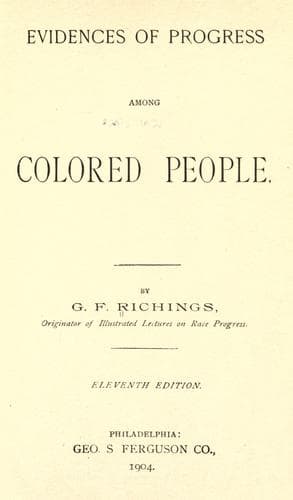
Evidences of Progress Among Colored PeopleRichings, G. F.
History
Evidences of Progress Among Colored People
Richings, G. F.
African Americans
In 1882 he was elected by the Trustees, Dean and Professor of Common
Law in the University Law School of Allen University, Columbia, S.
C., an incorporated institution of learning, under the auspices of the
A. M. E. Church. In 1883, he presented a class of four colored youths
to the Supreme Court of that State for examination for admission to
practise law, the result of his sole instruction--the institution being
too poor to hire a corps of law instructors. These colored youths,
the first in the history of the State, were examined in open court,
and having passed a most creditable examination, as told by the court
in open session, were admitted to practice, and became members of the
learned profession, and the peers under the law of those who, but
less than a quarter of a century before, held them or their parents
in slavery. In 1884, another class was presented by Mr. Straker,
examined and admitted by the court. Mr. Straker, having now severed his
connection with the law school, resumed the practice of his profession
at Columbia, S. C. He won great distinction in the management as
attorney for the defendant in the celebrated murder case of the State
vs. Coleman, reported in 12th S. C., the defence being insanity, in
which Mr. Straker was declared to have shown deep research in the law
of the plea of _transitoria mania_.
The prejudice of the community keeping distinct all business between
black and white of a professional character, Mr. Straker was unable to
support himself and family by his profession in the South, and after
giving the same a fair test, and spending fourteen years of his life in
the endeavor to uplift his race in the South, was compelled to seek
a new field. He came to Detroit, Mich., in 1887, bringing with him,
from his white fellow-citizens, the highest testimonials of ability
and character, who, while they disliked him politically, admired and
recognized his legal ability. This, with his own natural energy and
legal acumen, soon gave him distinction in his new home. He soon found
himself in a fairly lucrative practice, and had for his clients a
large number of whites, his own race being too poor to afford such. He
distinguished himself as an advocate of ability, as was seen in his
victory of the Civil Rights case of Ferguson vs. Gies, 82d Michigan,
which decision settled the status of the colored citizen within
Michigan, as to his right to accommodation in public places, equally
with his white fellow-citizen. His legal argument in this case fully
showed him a capable and learned attorney-at-law.
Public-domain text, read in full here on John Shaqi.
Reviews
Reviews
No reviews yet
Be the first to share your thoughts on this work.
Elsewhere in the archive
Join the Discussion
Join the discussion
Sign in to leave a comment or review.
Sign InorCreate an account