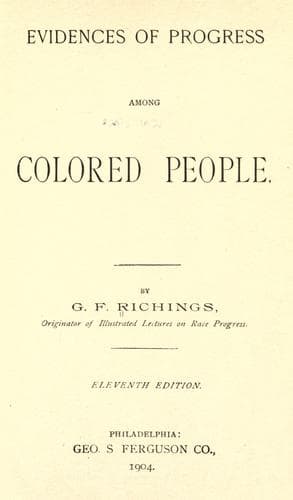
Evidences of Progress Among Colored PeopleRichings, G. F.
History
Evidences of Progress Among Colored People
Richings, G. F.
African Americans
In 1870 a desirable site for an institution for the education of
colored people was found available at Columbia, S. C. As this was the
capital of the State, and central, it was decided to locate it here. A
noble woman in New England, Mrs. B. A. Benedict, of Providence, R. I.,
gave $10,000 towards its purchase, the cost being $16,000. The property
consisted of nearly eighty acres of land. In honor of the deceased
husband of the donor, Dea. Stephen Benedict, brother of David Benedict,
the historian, the Board called the school "Benedict Institute."
It was opened December 1, 1870, under the charge of Rev. Timothy S.
Dodge, as principal. The first pupil was a colored preacher, sixty
years old. In October, 1887, Rev. Lewis Colby succeeded Mr. Dodge under
appointment of the Board.
Upon his resignation in 1879, Rev. E. J. Goodspeed, D. D., was
appointed. He entered upon his work in October, continuing until his
death, in the summer of 1881. Rev. C. E. Becker was selected as his
successor and went to Columbia in October, 1882, but at this writing
the president is Rev. A. C. Osborn, D. D.
During 1879-80, Rev. Lewis Colby, deeply impressed with the need of
better accommodations, especially for girls, devoted his time without
compensation, and with the approval of the Board, to raising $5,000
for a girls' building. This amount being secured, together with an
additional offering from Mrs. Benedict, two frame buildings were
erected in 1881. Towards the furnishing of the buildings, the colored
people of the State gave over $1,600. The girls' building is known as
"Colby Hall." Better quarters for the young men are greatly needed.
By special act of the South Carolina Legislature, through the efforts
of President Becker and the co-operation of leading Baptists, the
institution in 1882 was exempted from taxation.
LELAND UNIVERSITY.
Leland University was founded in 1870 for the higher education of such
men and women as desired to fit themselves for Christian citizenship,
either as ministers, teachers, or tradesmen. It is open to all persons
who are fitted to enjoy its advantages, without distinction of race,
color, or religious opinions. The University owes its existence to the
late Holbrook Chamberlain, Esq., of Brooklyn, N. Y., who erected the
buildings, assisted in its management, and at his death left to it
the bulk of his property, about $100,000, as an endowment fund, the
interest of which goes to the payment of teachers.
The University has a library and reading-room, which is supplied with
the leading journals and periodicals of the day.
There is a Literary Society, the "Philomathean," composed of young men
and young women, which holds weekly meetings for mutual improvement.
The students also constitute a recognized branch of the International
Young Men's Christian Association and of the National Society of
Christian Endeavor.
Public-domain text, read in full here on John Shaqi.
Reviews
Reviews
No reviews yet
Be the first to share your thoughts on this work.
Join the Discussion
Join the discussion
Sign in to leave a comment or review.
Sign InorCreate an account