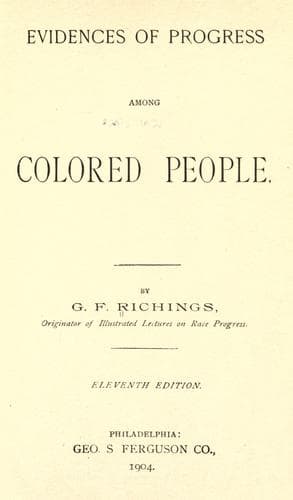
Evidences of Progress Among Colored PeopleRichings, G. F.
History
Evidences of Progress Among Colored People
Richings, G. F.
African Americans
Prof. E. Johnson, of Raleigh, N. C., now a teacher in the law
department of Shaw University, has written the only school history now
in use in Colored schools, which makes any reference to what Colored
people have done. I feel that Mr. Johnson did a grand work to get
his book into the public schools of North Carolina, and I only wish
such books could be in use in all Colored schools, for all over this
country, Colored children are being taught out of books which make no
reference whatever to what progress has been made by the race. It is
very hard to stimulate race pride without race information.
PROF. H. T. KEALING, B. S., A. M.
[Illustration: PROF. H. T. KEALING, B. S., A. M.]
The present editor of the _A. M. E. Church Review_, who takes Dr.
Coppin's place, is indeed a unique character and has filled some
important positions as an educator and writer. He was elected Assistant
Principal of Prairie View State Normal School of Texas in 1883. While
here he attracted much attention throughout the country by an impromptu
speech before the National Educational Association in Topeka, Kan.,
which the _New England Journal of Education_ pronounced the brightest
and wittiest piece of oratory in the whole session. He contributed in
1886 to _The Century Magazine_, of New York, for which he was well
paid. He at one time was supervisor of the Colored schools in Austin,
Tex. The position was created by the board for him. I know of no other
such case. For four years he was President of Paul Quinn College at
Waco, Tex. While there he added several new features to its curriculum.
During his vacations he spent his time in the South and Northwest as
a lecturer, and is now known as one of the best platform speakers in
the country regardless of color. His lecture, "The American Jonah,"
is unique, witty, forcible, and a popular favorite. As an editor he
has had some experience before and has been a regular contributor to
_Inter-Ocean_, _N. E. Journal of Education_, _Texas School Journal_,
_Galveston News_ and many other leading papers of the country. I am
sure the _A. M. E. Review_ has fallen into good hands. Mr. Kealing was
elected to his present position in May, 1896, at Wilmington, N. C.
PAUL L. DUNBAR
whose book of poems brought forth high praise from the Hoosier poet,
James Whitcomb Reilly. His book also attracted the attention of William
Dean Howell who wrote a splendid review of it in _Harper's Magazine_,
in which he said, "Mr. Dunbar's poems have given me a much higher
estimate of the Negro."
CHAPTER XXIV.
CHURCHES.
I shall not attempt to give a history of the various denominations with
which the colored people are identified. I simply desire to set forth
a few facts which indicate that they have, by vigorous efforts, made
the same wonderful progress along church lines that they have along
educational, industrial and professional lines.
The colored people are represented in nearly every denomination known
in the United States.
Public-domain text, read in full here on John Shaqi.
Reviews
Reviews
No reviews yet
Be the first to share your thoughts on this work.
Elsewhere in the archive
Join the Discussion
Join the discussion
Sign in to leave a comment or review.
Sign InorCreate an account