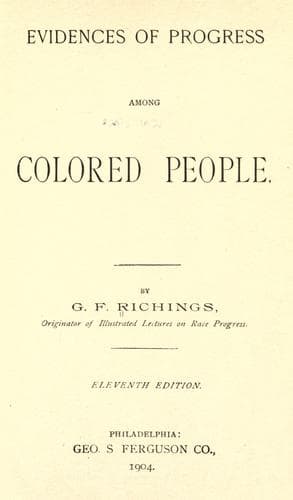
Evidences of Progress Among Colored PeopleRichings, G. F.
History
Evidences of Progress Among Colored People
Richings, G. F.
African Americans
The Baptists, Congregationalists, Episcopalians, Methodists Episcopal,
African Methodists Episcopal, African Methodists Episcopal Zion,
Colored Methodists Episcopal, Congregational Methodists Episcopal, the
Presbyterians, and other denominations are very well supported by the
colored people, and the church work has been a great help to the race
since 1865.
I cannot give the amount of space to this phase of the so-called Negro
problem that it deserves; but in order that my readers may get some
idea of the development of the race along religious lines, I offer here
a brief sketch of the Bethel A. M. E. Church, of Philadelphia, Pa., for
this is a fair representation of church work among the colored people
throughout the United States. And what is said of Bethel will apply to
all other denominations in proportion to their membership.
BETHEL A. M. E. CHURCH.
[Illustration: THE BEGINNING OF AFRICAN METHODISM.]
In November, 1787, the colored people belonging to the Methodist
Society of Philadelphia (St. George's) convened together, in order to
take into consideration the evils under which they labored, growing out
of the unkind treatment of their white brethren, who considered them a
nuisance in the house of worship, and even pulled them off their knees
while in the act of prayer and ordered them to the back seats.
For these and various other acts of unchristian conduct, they
considered it their duty to devise plans to build a house of their
own, that they might worship God under their own vine and fig-tree
unmolested.
The causes which produced Bethel were race prejudice on the one
hand and an innate desire of the heart for religious liberty and
determination on the other to be content with nothing less than an
opportunity for the exercise of the fullest Christian manhood in the
house of God.
Hence the organization in 1787 (November) of Bethel Society, the oldest
colored church organization in America. In 1793, Richard Allen, a
preacher and leading spirit among his brethren, proposed the erection
of a house of worship on his own ground, at his own expense, which
being acceded to by his brethren, the first church edifice was erected
on the present site of Bethel, Sixth street below Pine, Philadelphia,
Pa., which house of worship was duly consecrated and opened for divine
service by Francis Asbury, the then Bishop of the Methodist Episcopal
Church, at the invitation of Richard Allen. And the house was named
Bethel notwithstanding the severest persecutions at the hands of their
white brethren for a number of years. Bethel continued to grow in
usefulness and influence, both locally and generally. So that in the
year 1816 the spirit of Allen and his coadjutors had become so powerful
that the hour was ripe for the organization of a connection to carry on
the work everywhere so well begun by Bethel in Philadelphia.
Public-domain text, read in full here on John Shaqi.
Reviews
Reviews
No reviews yet
Be the first to share your thoughts on this work.
Elsewhere in the archive
Join the Discussion
Join the discussion
Sign in to leave a comment or review.
Sign InorCreate an account