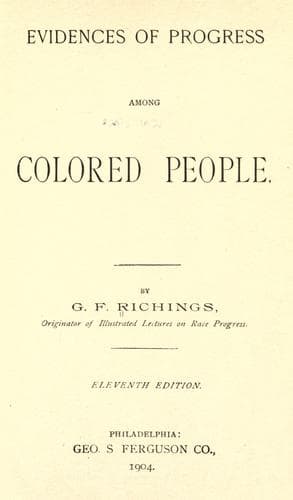
Evidences of Progress Among Colored PeopleRichings, G. F.
History
Evidences of Progress Among Colored People
Richings, G. F.
African Americans
The Friends' Freedmen Association of Philadelphia have placed the
Christiansburg Industrial Institute for the coming year under the
supervision of the officers of the Tuskegee Industrial Institute,
Tuskegee, Ala., which gives Booker T. Washington a general oversight of
that work.
CHAPTER XXIX.
HAMPTON INSTITUTE, HAMPTON, VA.
The Hampton Normal and Agricultural Institute first opened its doors
for the reception of the freedmen in April, 1868. Of its beginning and
purpose, General Armstrong, its founder and for twenty-five years its
principal, writes:
"Two and a half years' service with the Negro soldiers (after a
year as Captain and Major in the 125th New York Volunteers), as
Lieutenant-Colonel and Colonel of the Ninth and Eighth Regiments of
U. S. Colored Troops, convinced me of the excellent qualities and
capacities of the freedmen. Their quick response to good treatment
and to discipline was a constant surprise. Their tidiness, devotion
to their duty and their leaders, their dash and daring in battle,
and ambition to improve--often studying their spelling books under
fire--showed that slavery was a false, though doubtless, for the time
being, an educative condition, and that they deserved as good a chance
as any people.
"In March, 1866, I was placed by General O. O. Howard, Commissioner of
the Freedmen's Bureau, in charge of ten counties in Eastern Virginia,
with headquarters at Hampton, the great 'contraband' camp, to manage
Negro affairs and adjust, if possible, the relation of the races.
[Illustration: HAMPTON ROADS, FROM PRINCIPAL'S OFFICE.]
"I soon felt the fitness of this historic and strategic spot for a
permanent and great educational work. The suggestion was cordially
received by the American Missionary Association, which authorized the
purchase, in June, 1867, of 'Little Scotland,' an estate of 125 acres
on Hampton River, looking out over Hampton Roads. Not expecting to
have charge, but only to help, I was surprised, one day, by a letter
from Secretary E. P. Smith, of the A. M. A., stating that the man
selected for the place had declined, and asking me if I could take it.
I replied, 'Yes.' Till then my own future had been blind; it had only
been clear that there was a work to be done for the ex-slaves and where
and how it should be done.
"A day-dream of the Hampton School, nearly as it is, had come to me
during the war a few times; once in camp during the siege of Richmond,
and once one beautiful evening on the Gulf of Mexico, while on the
wheel-house of the transport steamship Illinois, enroute for Texas with
the 25th Army Corps (Negro) for frontier duty on the Rio Grande River,
whither it had been ordered, under General Sheridan, to watch and if
necessary defeat Maximilian in his attempted conquest of Mexico.
Public-domain text, read in full here on John Shaqi.
Reviews
Reviews
No reviews yet
Be the first to share your thoughts on this work.
Elsewhere in the archive
Join the Discussion
Join the discussion
Sign in to leave a comment or review.
Sign InorCreate an account