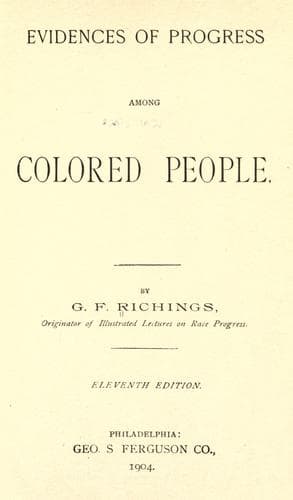
Evidences of Progress Among Colored PeopleRichings, G. F.
History
Evidences of Progress Among Colored People
Richings, G. F.
African Americans
"The thing to be done was clear: to train selected Negro youth who
should go out and teach and lead their people, first by example by
getting land and homes; to give them not a dollar that they could earn
for themselves; to teach respect for labor; to replace stupid drudgery
with skilled hands; and, to these ends, to build up an industrial
system, for the sake not only of self-support and intelligent labor,
but also for the sake of character. And it seemed equally clear that
the people of the country would support a wise work for the freedmen."
[Illustration: HAMPTON INSTITUTE, 1868.]
Thus, under a man of the broadest views and almost prophetic
foresight, the school had its beginning. Two teachers and fifteen
students found living room and class room in the dismantled mansion,
the old brick mill and the newer barracks, relics of the slavery days
and of the civil war. At the end of the school's twenty-fifth year
Gen. Armstrong died, seeing, as it is given to few to see, great and
tangible results from his years of self-sacrificing labor. Since his
death, the work has been carried on by Rev. H. B. Frissell, D. D., who
has taken up with wisdom and courage the task laid upon him and has a
record behind him now of five years, during which the institution has
shown steady growth and improvement.
[Illustration: HAMPTON INSTITUTE, 1898.]
At the beginning of the present year there were on the grounds 1,001
students; of these 135 are Indians representing ten States and
Territories; 361 are children coming from the immediate neighborhood,
who are instructed in the Whittier Primary School. There are 630
boarders--383 boys and 247 girls. Of the eighty officers, teachers, and
assistants, about one-half are in the industrial department.
[Illustration: TRADE SCHOOL BUILDING.]
Instead of the old barracks, there are now over fifty-five buildings,
including dormitories, academic and science buildings, a large trade
school, domestic science and agricultural buildings, a beautiful
church, a large saw-mill and shops where students help to earn
their board and clothes and receive instruction in blacksmithing,
wheelwrighting, painting, house-building, cabinet-making, upholstery,
shoemaking, tailoring, harness-making, printing, and engineering. Two
large farms with greenhouses, barns, and experiment stations give
employment to students and instruction in agriculture. The laundry,
dining-rooms, kitchens, and sewing-rooms give employment to the
girls, and in them they receive instruction in sewing, dressmaking,
laundering, and other branches which fit them to instruct their people
in these lines. All the domestic work of the place is performed by the
students. The average age of the pupils is nineteen years.
[Illustration: ACADEMIC CLASS-ROOM.]
Public-domain text, read in full here on John Shaqi.
Reviews
Reviews
No reviews yet
Be the first to share your thoughts on this work.
Elsewhere in the archive
Join the Discussion
Join the discussion
Sign in to leave a comment or review.
Sign InorCreate an account