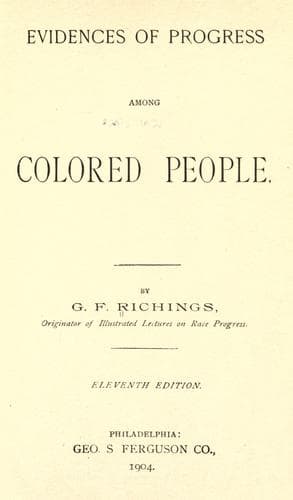
Evidences of Progress Among Colored PeopleRichings, G. F.
History
Evidences of Progress Among Colored People
Richings, G. F.
African Americans
Those who wish to fit themselves to become teachers in the public
schools, after graduation from the Academic Department, enter the
Normal Department, where they receive instruction in methods of
teaching, and have practice in the Whittier School, in which there are
over three hundred children, with kindergarten and classes in cooking,
gymnastics, and the English branches.
The boys are formed into a battalion under the Commandant of Cadets,
a graduate of the school, from whom they receive military drill and
gymnastic training. A United States officer from Fort Monroe assists
in this work. The care of persons, quarters, and grounds are largely
under the care of the officers of the school battalion. The girls are
similarly organized under their matrons and are instructed in habits
and manners.
The school is non-sectarian but earnestly Christian. Careful
instruction in the Bible is given by teachers representing different
denominations. The Chaplain is assisted by the clergymen of Hampton in
the religious work of the school.
[Illustration: TRADE SCHOOL PAINT SHOP.]
Six thousand young people of the Negro and Indian races have had the
advantages of the school's training and gone out as teachers, farmers,
and business men, to lift their people to a higher level. Nearly 1,000
have graduated from the school's Academic Department, and of these 90
per cent. have become teachers. The great majority have gone into the
public schools. Whole counties have been transformed by their work.
Homes, churches, and schools have been built, land purchased, and the
morals of the community improved.
Booker T. Washington, a graduate of Hampton, founded the Tuskegee
School in Alabama, and over forty other graduates have gone to help him
in his work. Schools at Calhoun and Mt. Meigs, Alabama, Kittrell, North
Carolina, Lawrenceville and Gloucester, Virginia, are established on
the Hampton plan and carried on by graduates of the school. Under the
teachers who have gone out from Hampton and its offshoots more than
150,000 children have received instruction. Of the 500 Indians who
have been trained at Hampton, 87 per cent. are engaged as teachers,
farmers, missionaries, and in other regular occupations. Twenty years
ago, Capt. Pratt brought fifteen prisoners of war from Fort Marion,
St. Augustine, to Hampton and remained there one year, bringing in the
meantime other Indians from the West. So successful was that first
experiment in industrial education that Carlisle School was established
and now hundreds of thousands of dollars, which were formerly devoted
to fighting the Indians, are given by the government to training their
children in industrial schools.
Hampton has given an impetus to industrial education among the Negroes
which is felt in every State of the South. But 75 per cent. of the
race still live in one-room cabins on rented land, in ignorance and
poverty. Teachers of agriculture and home builders are needed.
[Illustration: WHEELWRIGHT SHOP.]
Public-domain text, read in full here on John Shaqi.
Reviews
Reviews
No reviews yet
Be the first to share your thoughts on this work.
Elsewhere in the archive
Join the Discussion
Join the discussion
Sign in to leave a comment or review.
Sign InorCreate an account