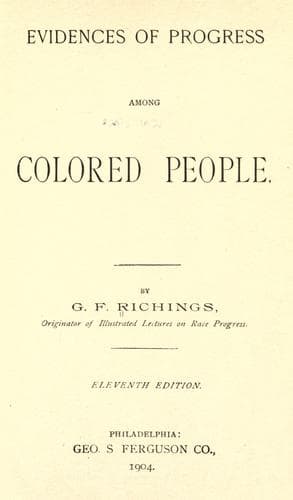
Evidences of Progress Among Colored PeopleRichings, G. F.
History
Evidences of Progress Among Colored People
Richings, G. F.
African Americans
In 1870 this institution was chartered by special act of the General
Assembly of Virginia. It is not owned or controlled by State or
government, but by a Board of seventeen Trustees, representing
different sections of the country, and six religious denominations,
no one of which has a majority. The school now has a property worth
over $600,000, free from debt, and an endowment fund of over a
half-million. It receives aid through the State of Virginia for its
agricultural work and from the general government toward the board
and clothes of Indians, but it is obliged to appeal to the public for
$80,000 a year.
The Slater Fund Board makes a generous yearly appropriation toward
its trade-school work, and help is received from the Peabody Fund,
but the school depends for the large part of its yearly expenses upon
charitable contributions.
[Illustration: GIRLS' MANUAL TRAINING.]
Twenty-five years ago the imperative need of the Negro was teachers in
the country public schools of the South, who could show the people by
example, as well as by precept, how to live, how to get land and build
decent houses. This need still remains, but, with the improvement of
the colored race, more thoroughly equipped teachers are necessary,
not only for the public schools, but for the workshops, and for the
industrial and agricultural schools that have started up all through
the South and among the Indians of the West. To meet this need Hampton
provides an Academic Department with a corps of able teachers, mostly
graduates of normal schools and colleges, who give thorough instruction
in the English branches. Beside this, manual training is given to the
boys, and sewing, cooking, and bench work to the girls. Those of the
boys who show aptitude for trades in the manual training classes can
receive thorough instruction in the Trade School, a building costing
$50,000 and especially adapted to the work. Competent instruction in
carpentry, wood turning, cabinet-making, bricklaying, plastering,
wheelwrighting, blacksmithing, painting, machine work, and mechanical
drawing carry students through a systematic course in their different
departments, fitting them to be teachers of trades. Chance is also
given to do actual work in the sixteen productive industries on the
school grounds.
[Illustration: KINDERGARTEN CLASS.]
Those of the girls who wish trades can be admitted into the Domestic
Science Department where they are fitted to be teachers of sewing,
cooking, and laundering, with an opportunity to do actual work in the
school's laundry and kitchen.
All students of the school receive instruction in agriculture, but
those who wish to devote themselves especially to it can receive
special instruction in the Agricultural Department, with experiments in
the laboratory and practical work upon the school's two farms.
Public-domain text, read in full here on John Shaqi.
Reviews
Reviews
No reviews yet
Be the first to share your thoughts on this work.
Elsewhere in the archive
Join the Discussion
Join the discussion
Sign in to leave a comment or review.
Sign InorCreate an account