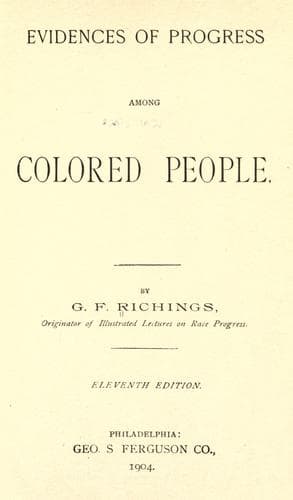
Evidences of Progress Among Colored PeopleRichings, G. F.
History
Evidences of Progress Among Colored People
Richings, G. F.
African Americans
Stone Hall, with the ground upon which it stands, is a fine monument to
the considerate generosity of Mrs. Valeria G. Stone, of Malden, Mass.
It is a dormitory for the girls, and the home of the President and most
of the teachers. Here, too, are the kitchen and the cool and spacious
dining room.
The general housekeeping is under the supervision of an efficient
matron, and an experienced and competent preceptress teaches the girls
how to care for their rooms and their health, and trains them in the
manners of a refined, Christian home. In a word, the whole management
of Stone Hall, with the constant inculcation of the principles of good
breeding by precept and example, is an impressive object-lesson to the
students of what constitutes the ideal Christian family.
Whitin Hall, a dormitory for boys, is a memorial of the generosity of
Hon. Seymour Straight and the late John C. Whitin, of Massachusetts.
This is under the charge of an accomplished matron.
BEACH INSTITUTE.
Beach Institute is located at Savannah, Ga.; Miss M. L. Graham,
Principal.
The educational movement which finally took the name "Beach Institute"
began thus:
Soon after the surrender of Savannah to General Sherman, educational
work for colored people was begun under the direction of an
"Educational Commission," organized by Rev. J. W. Alvord and Rev. M.
French. The first schools were opened by Rev. W. F. Richardson with the
aid of colored teachers in the old slave mart and the Styles building
in Yamacraw.
Soon after, Rev. S. W. Magill, a native of Georgia and agent of the
American Missionary Association in Connecticut, came from the North
with a corps of competent teachers and opened a school in the Methodist
Church on South Broad street. At the close of the first week 300
children and 118 women were enrolled. The school soon outgrew its
quarters and was removed to the Massie school on Gordon street, which
building was assigned to this service by General Grover, commander of
the district.
Previous to 1867 the colored Methodist Church, New street; Lamar Hall,
Liberty street; the lecture rooms of First and Bryan Baptist Churches;
Sturtevant Hall, an old wooden structure on the site of present
buildings at corner of Price and Harris streets, sheltered this A. M.
A. work.
In 1867 commodious buildings were erected by the American Missionary
Association, and dedicated as Beach Institute, in honor of Alfred E.
Beach, Esq., editor of the _Scientific American_, who donated the funds
to purchase the site.
There were 600 scholars, with ten teachers, at this time.
The teachers' home, 30 Harris street, was first occupied on
Thanksgiving day, 1867.
The attendance and teaching force remained at about the same numbers
until 1875, when the building was rented to the city for the use of the
public school conducted by the Board of Education.
Public-domain text, read in full here on John Shaqi.
Reviews
Reviews
No reviews yet
Be the first to share your thoughts on this work.
Join the Discussion
Join the discussion
Sign in to leave a comment or review.
Sign InorCreate an account