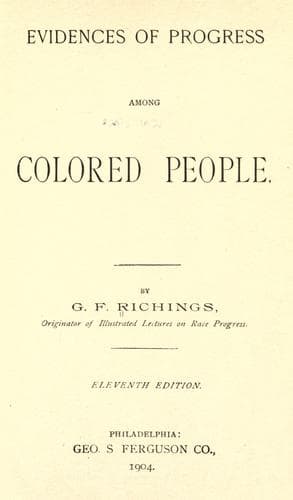
Evidences of Progress Among Colored PeopleRichings, G. F.
History
Evidences of Progress Among Colored People
Richings, G. F.
African Americans
I think that I can safely say that the only white people who are
willing to admit that there is a better class of colored people, are
those who have either taught in their institutions, or have intimate
friends engaged in that kind of work. Friends who are anxious to help
the race, find that these wrong impressions have been so thoroughly
established, that the educational work is very much hampered and
interfered with from year to year; and the success of Southern schools,
dependent on Northern philanthropy, has been very much hindered on
account of the gloomy aspect given by Northern people visiting Southern
cities. The contributions from the North to these schools, have been
very meagre and, of course, the higher possibilities of negro education
have not been reached. Enemies of the race, and those laboring under
false impressions, are led to believe that the money invested in
Southern Educational Institutions has been simply thrown away. We
cannot hope for a change for the better as long as colored people are
only known as coachmen, waiters, cooks, and washerwomen.
I have called your attention to a very gloomy aspect of the Southern
situation. But while the aspect is a gloomy one, it represents the true
attitude of the American people, with a few exceptions. I have put
forth this effort to set my friends right on this important question,
and I sincerely believe that the time is not far distant when the white
people will see to it that these Southern Institutions are guaranteed
more liberal support and better encouragement. I see the colored people
in a much brighter light and in a more hopeful condition than the men
of my race who visit the South for the purpose of making superficial
observations. And because I have found so many interesting "Evidences
of Progress Among Colored People," I offer this as my apology for
writing this book. The facts contained in this work have been gathered
during sixteen years of actual labor and contact with the colored
people in all parts of the United States. I have had to go deeper
into the question, to secure my information, than merely to visit
street-corners and hold casual conversation with the unfortunate and
the unemployed, North or South.
When those who read this book take into consideration the fact that
many of the characters herein mentioned started some thirty years ago
without a dollar, without a home, and without education, except here
and there a few who had, in some mysterious way, learned to read and
write, they will, I am sure, be willing to admit that some progress
has been made by the people in whose interest this book is published.
I wish to make prominent four phases of the race question, namely:
(1) The schools which have been built for colored people and managed
by whites; (2) The schools managed by colored people; (3) The church
work carried on among them, and (4) The business and professional
development as the result of education.
Public-domain text, read in full here on John Shaqi.
Reviews
Reviews
No reviews yet
Be the first to share your thoughts on this work.
Join the Discussion
Join the discussion
Sign in to leave a comment or review.
Sign InorCreate an account