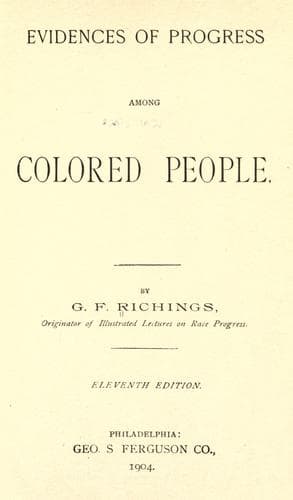
Evidences of Progress Among Colored People — John Shaqi
Evidences of Progress Among Colored PeopleRichings, G. F.
History
Evidences of Progress Among Colored People
Richings, G. F.
African Americans
In its normal work, the school is continually sending forth a stream
of teachers for the public schools as well as for the Church schools.
There is little danger of carrying on higher education, as some have
thought. The greatest difficulty is in securing, at this stage of the
race's development, students who have the grit to persevere in their
school work so as to reach the higher classes.
The school has an endowment of about $30,000, of which $25,000 reverts
to the Board of Managers of Missions, in case of impairment or misuse.
There are large buildings for both girls and young men. Two of the
buildings have been erected almost entirely by the students.
CHAPTERS V. AND VI.
METHODIST SCHOOLS.
The Methodist Church has been very active in its educational work at
the South, and its schools rank among the very best. It is noticeable
that this church has paid special attention to industrial education
among the colored people. I have visited some of these schools and I
was pleased to see how highly the young men and young women appreciate
the opportunities afforded them to learn trades and professions.
WALDEN UNIVERSITY.
At the close of the Rebellion in 1865, the condition of the emancipated
slaves attracted the attention of patriots, philanthropists, and
Christians North and South. There were millions of them ignorant of
books and of their duty as freedmen. They were poor, having only the
clothes they wore, or if they had other property, it could usually
be carried in a bundle in the hand or on the head. All the leading
religious denominations of the North entered this field of missionary
work--the Methodist Episcopal Church among the first. In 1865 the
missionary society of this church appropriated $10,000 to establish a
school for the freedmen in the South. This sum was placed under the
direction of Rev. Bishop D. W. Clark, D. D., who, having visited
Nashville, authorized Rev. John Seys and Rev. O. O. Knight to open a
school in Clark Chapel, a church building purchased from the M. E.
Church, South, and then known as Andrew Chapel. Rev. O. O. Knight was
principal, assisted by Mrs. Julia North, Mrs. Mary Murphy, and Miss O.
D. Barber. All of the assistants were colored. The school was composed
of scholars of all ages and sizes--grandparents and grandchildren,
parents and children, were in the same classes. They were poorly
clad, and mostly homeless wanderers from the plantations. They found
shelter in the army barracks, in abandoned houses, in cellars or
garrets, stables, or other out-houses--whatever would afford them
a present shelter. Yet in the midst of this destitution they were
hungry for education. Never did teachers have more earnest pupils.
The crowded condition of the church soon led the teachers to seek for
better accommodations, and the next year the school was moved into the
building known as the Gun Factory.
[Illustration: WALDEN UNIVERSITY.
_Dr. J. Benson Hamilton, President._]
Public-domain text, read in full here on John Shaqi.
Reviews
Reviews
No reviews yet
Be the first to share your thoughts on this work.
Join the Discussion
Join the discussion
Sign in to leave a comment or review.
Sign InorCreate an account