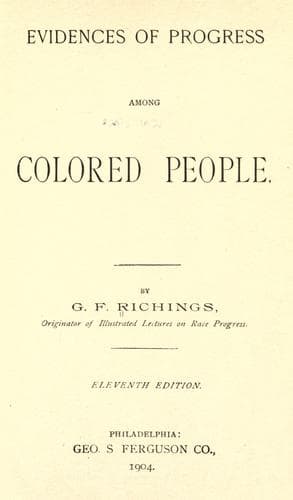
Evidences of Progress Among Colored PeopleRichings, G. F.
History
Evidences of Progress Among Colored People
Richings, G. F.
African Americans
In the fall of 1885 the necessity for more buildings caused Dr. Price
to visit the Pacific coast. After lecturing about four months he
secured the donation of $5,000 from the late Senator Leland Stanford
and $1,000 from Mrs. Mark Hopkins. The entire amount collected by Dr.
Price on the coast was about $9,000. Only a little over $1,000 was
needed to make up the sum of $20,000. The Hon. Wm. E. Dodge, who had
assisted Mr. Price through school, promised him a donation of $5,000
if he should raise that sum. Mr. Price lost no time in securing the
residue and Mr. Dodge kept his word.
In March, 1886, ground was broken for the erection of a dormitory for
boys--Dodge Hall--a four-story brick building 60 × 40, and a four-story
brick, 100 × 40, for girls, known as Hopkins Hall, forming a nucleus
to Stanford Seminary. It will be observed that all these buildings are
named for their principal donors.
In 1887, Mr. Stephen F. Ballard of New York erected the Ballard
Industrial Hall (60 × 39) and fitted it up with complete outfits for
the department of carpentry, shoemaking and printing. The entire
valuation of the buildings and grounds (now about fifty acres) is
estimated at $100,000.
The aim of the school has been to give a thorough literary training
to colored young men and women. The industrial feature has not been
neglected, although recently the school has not been able to do as much
in that line as formerly. The reason for this has been the withdrawal
of the Slater Fund. However, this department has been operating with
such means as the officers have been able to obtain. The students
in the carpentry shop make and repair all the furniture used in the
school, such as bedsteads, chairs, tables, desks, washstands and
dressers. The printing office is well equipped and much minute and
pamphlet work has been done besides the publishing of the College
journal, which is now conceded to be one of the best, if not the best,
College magazine published by a colored institution in the country.
The institution has been running but little over a decade. It boasts,
however, of a prominence equal to any institution in the south founded
and sustained by colored men. The character of its graduates and the
showing they have made bespeak the thoroughness of its work. In fact,
the officers of the institution, while recognizing the need and the
cry for the industrial training of the Negro, have stoutly maintained
that industrial education should not supplant the higher educational
development of the Negro. The success of the 130 graduates since '85
has been sufficient argument for them to hold this point.
Public-domain text, read in full here on John Shaqi.
Reviews
Reviews
No reviews yet
Be the first to share your thoughts on this work.
Elsewhere in the archive
Join the Discussion
Join the discussion
Sign in to leave a comment or review.
Sign InorCreate an account