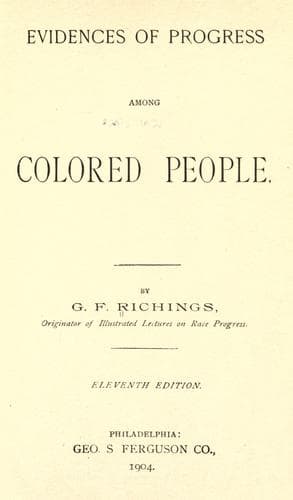
Evidences of Progress Among Colored PeopleRichings, G. F.
History
Evidences of Progress Among Colored People
Richings, G. F.
African Americans
While the State Normal and Industrial School, at Normal, Alabama, has
made little display through the public prints, it is a fact that it
is doing a great work for Negro Education, and stands among the best
schools of the land.
This institution, like many others in the South, is the work of
sacrifice and charity. The early teachers taught for a bare living in
order to make the school a fixture. Prof. Councill, the founder and
president of the school, gave his entire earnings for more than ten
years to the work. The documents which the teachers signed, donating
their salaries to the cause of education of the Negro race, is a part
of the records of the institution, and a witness of their devotion and
consecration to the work.
[Illustration: OLD SLAVE CABIN--PRESIDENT'S OFFICE, 1891-94.]
The school began its existence in the city of Huntsville, Ala., May 1,
1875. It was first taught in a little church, and then in rented houses
about the city until, September 1, 1882, a beautiful lot consisting of
five acres of land, on which stood several buildings, was purchased and
the school permanently located.
[Illustration: ONLY SCHOOL PROF. COUNCILL EVER ATTENDED.]
Beginning May 1, 1875, with not one dollar in property, only one
teacher, nineteen pupils, annual income of $1,000, in 1878, its work
was so satisfactory that the annual appropriation was increased to
$2,000, and it then had four teachers and over 200 pupils. The Peabody
and Slater funds made liberal contributions to its support. In 1884,
the Alabama Legislature increased the annual appropriation to $4,000,
the city of Huntsville gave aid, and warm friends, North and South,
contributed liberally. The old buildings on the grounds were improved,
and by 1890, two large handsome brick buildings, one large frame
dormitory for young men, and a commodious industrial building had
been erected and fitted up; the faculty had been increased to eleven
teachers, and more than 300 students were receiving instruction in a
thorough Normal Course and in important industries. The Legislature
of Alabama, in further recognition of the merits of this institution,
selected it as the recipient of that portion of the Congressional grant
under act approved August 30, 1890, known as the Morrill Fund "for the
more complete endowment and maintenance of colleges for the benefit
of agriculture and the mechanic arts," given to Alabama for Negro
Education. This action of the Legislature gave new force and broader
scope to the work. It was seen that larger quarters were necessary,
that the beautiful grounds, handsome buildings supplied with gas and
water, must be given up and the school removed from Huntsville to some
suitable place near by. A great many locations were offered, and,
after due consideration, the present location was purchased. Palmer
Hall and Seay Hall, a barn and a dairy were erected and the session
opened for 1891-2, September 1, in its new quarters--three months
Public-domain text, read in full here on John Shaqi.
Reviews
Reviews
No reviews yet
Be the first to share your thoughts on this work.
Elsewhere in the archive
Join the Discussion
Join the discussion
Sign in to leave a comment or review.
Sign InorCreate an account