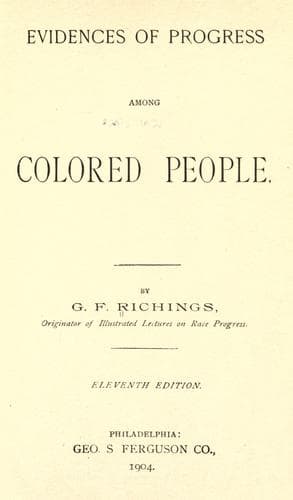
Evidences of Progress Among Colored PeopleRichings, G. F.
History
Evidences of Progress Among Colored People
Richings, G. F.
African Americans
Professor W. B. Weaver, the principal of the Gloucester Agricultural
and Industrial School--was born April 7, 1852, at Winton, N. C. The
first school he attended was taught by his oldest brother under a cart
shelter, from there to a log hut which had been used as a barn, making
seats out of boxes and plank boards. In 1869 he spent a few months
in a public school, where he was advanced to the grade from which he
could enter Hampton Normal and Agricultural Institute, Hampton, Va. He
worked his way through, and in 1873 began teaching his first school, in
his native State, having in his school 112 pupils. In 1875 and 1876 he
taught in the Valley of Virginia, in 1878, at Williamsport, Pa., and in
the fall of 1879, he returned to Virginia, and looking for a fruitful
field, was sent by Gen. S. C. Armstrong to Gloucester county, where he
began this noble effort for the uplifting of his race. He opened school
in December, 1879, in a little log cabin, which was used by slaves as
a meeting-house before the war. In this dark room he taught over 75
pupils. He soon caused the people in the community to see and feel the
need of education; and securing the co-operation of the School Board
and by the aid of the colored people, a two-story building was erected
known as Bethel Public School-house. Here 196 pupils were in attendance
and three teachers employed. His school did not close at the end of the
public school term of five months as other schools; but by keeping the
people interested, he raised money enough to continue for eight months.
[Illustration: THE LOG CABIN.]
Seeing the need of an industrial school for Gloucester and surrounding
counties, he gave up the public school work and entered upon the work
of establishing an industrial school. An educational mass-meeting
was called in which the Board of Trustees were elected. Prof. Weaver
then commenced the work of raising money for the proposed school. In
October, 1888, he opened school with four pupils in a board house once
used for a store. Coming out of a well-arranged crowded school-room
into this dilapidated make-shift with only four pupils, made him feel
strange. But having made a start in the direction which he believed
to be right, he did not look back, but daily pressed on the work of
teaching.
[Illustration: BETHEL PUBLIC SCHOOL.]
In 1890, thirty-three acres of land were bought and Richmond Hall
commenced. In October of that year he opened school in this building
though only partly finished.
[Illustration: RICHMOND HALL.]
Since that time 120 acres more of land have been purchased, a large
farm put under cultivation, other buildings erected, and industrial
shops opened. One large building known as Douglass Hall has recently
been erected and in use, though not completed. It is a three-story
building 78 × 60 in size and will cost, when completed, upward of
$6,000.
Public-domain text, read in full here on John Shaqi.
Reviews
Reviews
No reviews yet
Be the first to share your thoughts on this work.
Elsewhere in the archive
Join the Discussion
Join the discussion
Sign in to leave a comment or review.
Sign InorCreate an account