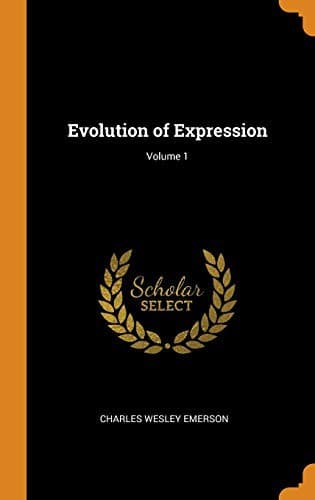
Evolution of Expression — Volume 1Emerson, Charles Wesley
Science
Evolution of Expression — Volume 1
Emerson, Charles Wesley
Elocution; Recitations
In choosing the selections for this and the accompanying volumes,
the aim has been to preserve the natural oneness between the study
of literature and that of expression, and to encourage the
appreciation of this unity in the minds of teacher and student. It
may be said that the greatest of the world's literature was
written for the ear, not for the eye, and its noblest influence is
felt only when it is adequately voiced by an intelligent and
sympathetic reader. It is the object of these volumes to foster in
the student a keener and deeper appreciation of the truth and
beauty of great prose and verse, and at the same time to enrich
his own and other lives by cultivating the power of expressing the
glories which are opened to his vision.
The arrangement of the selections is for the purpose of teaching
the art of reading according to the steps of natural evolution
hinted at in the foregoing pages, and in a way which experience
has found most prolific in practical results.
While no effort has been made to search for novelties, great care
has been taken to secure selections which, while of pure literary
merit, are especially adapted for drill in the several steps of
progress in reading. The power developed in the student through
carefully directed drill on these selections will enable him to
illuminate whatever other literature he may care to interpret. The
arrangement of the selections in small divisions or paragraphs has
been made for convenience in the work of the class room.
The "Evolution of Expression" does not offer art criteria by which
the work of an orator is to be measured; it presents rather a
system of education by which one may attain the plane of art in
expression. The teacher or student who desires a formulation of
laws which afford a standard of art criticism is referred to the
four volumes of "The Perfective Laws of Art," the text-book
succeeding the "Evolution of Expression."
The author wishes to express his sincere gratitude to George N.
Morang & Co., to Bobbs-Merrill Company, and to Houghton, Mifflin &
Co., for their courtesy in allowing him to reprint in this volume
selections from their publications.
THE WHOLE.
THE COLOSSAL PERIOD.
The body is one and hath many members, and all the members
of that one body, being many, are one body.--ST. PAUL.
How good is man's life, the mere living! How fit to employ
All the heart and the soul and the senses forever in joy!
--BROWNING.
CHAPTER I.
ANIMATION.
(NOTE.--Let the teacher and student remember that the headings of
the chapters name effects rather than causes, signs rather than
things signified. They are not, therefore, objects of thought for
the student while practising; they are finger points for the
teacher; the criteria by which he measures his pupil's
development.)
Public-domain text, read in full here on John Shaqi.
Reviews
Reviews
No reviews yet
Be the first to share your thoughts on this work.
Join the Discussion
Join the discussion
Sign in to leave a comment or review.
Sign InorCreate an account