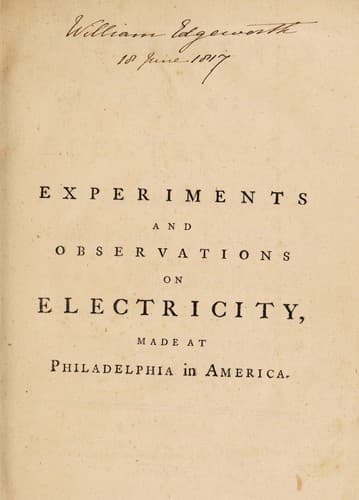
Experiments and Observations on Electricity Made at Philadelphia in AmericaFranklin, Benjamin
History
Experiments and Observations on Electricity Made at Philadelphia in America
Franklin, Benjamin
Electricity -- Early works to 1850
7. Particles happening to be situated as _A_ and _B_, are more easily
disengaged than _C_ and _D_, as each is held by contact with three only,
whereas _C_ and _D_ are each in contact with nine. When the surface of
water has the least motion, particles are continually pushed into the
situation represented by FIG. 6.
8. Friction between a non-electric and an electric _per se_, will produce
electrical fire; not by _creating_, but _collecting_ it: for it is equally
diffused in our walls, floors, earth, and the whole mass of common matter.
Thus the whirling glass globe, during its friction against the cushion,
draws fire from the cushion, the cushion is supplied from the frame of the
machine, that from the floor on which it stands. Cut off the communication
by thick glass or wax placed under the cushion, and no fire can be
_produced_, because it cannot be _collected_.
9. The Ocean is a compound of water, a non-electric, and salt an electric
_per se_.
10. When there is a friction among the parts near its surface, the
electrical fire is collected from the parts below. It is then plainly
visible in the night; it appears at the stern and in the wake of every
sailing vessel; every dash of an oar shows it, and every surff and spray:
in storms the whole sea seems on fire.--The detach'd particles of water
then repelled from the electrified surface, continually carry off the fire
as it is collected; they rise, and form clouds, and those clouds are highly
electrified, and retain the fire 'till they have an opportunity of
communicating it.
11. The particles of water rising in vapours, attach themselves to
particles of air.
12. The particles of air are said to be hard, round, separate and distant
from each other; every particle strongly repelling every other particle,
whereby they recede from each other, as far as common gravity will permit.
13. The space between any three particles equally repelling each other,
will be an equilateral triangle.
14. In air compressed, these triangles are smaller; in rarified Air they
are larger.
15. Common fire joined with air, increases the repulsion, enlarges the
triangles, and thereby makes the air specifically lighter. Such Air among
denser air, will rise.
16. Common fire, as well as electrical fire gives repulsion to the
particles of water, and destroys their attraction of cohesion; hence common
fire, as well as electrical fire, assists in raising vapours.
17. Particles of water, having no fire in them, mutually attract each
other. Three particles of water then being attached to the three particles
of a triangle of air, would by their mutual attraction operating against
the air's repulsion, shorten the sides and lessen the triangle, whereby
that portion of air being made denser, would sink to the earth with its
water, and not rise to contribute to the formation of a cloud.
Public-domain text, read in full here on John Shaqi.
Reviews
Reviews
No reviews yet
Be the first to share your thoughts on this work.
Join the Discussion
Join the discussion
Sign in to leave a comment or review.
Sign InorCreate an account