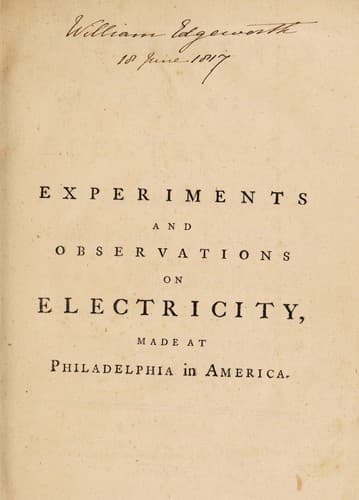
Experiments and Observations on Electricity Made at Philadelphia in AmericaFranklin, Benjamin
History
Experiments and Observations on Electricity Made at Philadelphia in America
Franklin, Benjamin
Electricity -- Early works to 1850
2. At the same time that the wire and top of the bottle, &c. is electrised
_positively_ or _plus_, the bottom of the bottle is electrised _negatively_
or _minus_, in exact proportion: _i. e._ whatever quantity of electrical
fire is thrown in at top, an equal quantity goes out of the bottom. To
understand this, suppose the common quantity of Electricity in each part of
the bottle, before the operation begins, is equal to 20; and at every
stroke of the tube, suppose a quantity equal to 1 is thrown in; then, after
the first stroke, the quantity contain'd in the wire and upper part of the
bottle will be 21, in the bottom 19. After the second, the upper part will
have 22, the lower 18, and so on 'till after 20 strokes, the upper part
will have a quantity of electrical fire equal to 40, the lower part none:
and then the operation ends: for no more can be thrown into the upper part,
when no more can be driven out of the lower part. If you attempt to throw
more in, it is spued back thro' the wire, or flies out in loud cracks thro'
the sides of the bottle.
3. The equilibrium cannot be restored in the bottle by _inward_
communication or contact of the parts; but it must be done by a
communication formed _without_ the bottle, between the top and bottom, by
some non-electric, touching both at the same time; in which case it is
restored with a violence and quickness inexpressible: or, touching each
alternately, in which case the equilibrium is restored by degrees.
4. As no more electrical fire can be thrown into the top of the bottle,
when all is driven out of the bottom, so in a bottle not yet electrised,
none can be thrown into the top, when none _can_ get out at the bottom;
which happens either when the bottom is too thick, or when the bottle is
placed on an electric _per se_. Again, when the bottle is electrised, but
little of the electrical fire can be _drawn out_ from the top, by touching
the wire, unless an equal quantity can at the same time _get in_ at the
bottom. Thus, place an electrised bottle on clean glass or dry wax, and you
will not, by touching the wire, get out the fire from the top. Place it on
a non-electric, and touch the wire, you will get it out in a short time;
but soonest when you form a direct communication as above.
Public-domain text, read in full here on John Shaqi.
Reviews
Reviews
No reviews yet
Be the first to share your thoughts on this work.
Join the Discussion
Join the discussion
Sign in to leave a comment or review.
Sign InorCreate an account