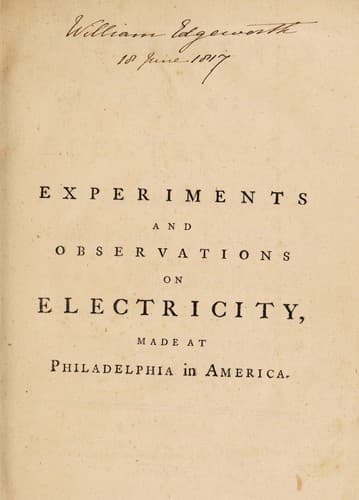
Experiments and Observations on Electricity Made at Philadelphia in AmericaFranklin, Benjamin
History
Experiments and Observations on Electricity Made at Philadelphia in America
Franklin, Benjamin
Electricity -- Early works to 1850
6. Thus common matter is a kind of spunge to the electrical fluid. And as a
spunge would receive no water, if the parts of water were not smaller than
the pores of the spunge; and even then but slowly, if there were not a
mutual attraction between those parts and the parts of the spunge; and
would still imbibe it faster, if the mutual attraction among the parts of
the water did not impede, some force being required to separate them; and
fastest, if, instead of attraction, there were a mutual repulsion among
those parts, which would act in conjunction with the attraction of the
spunge. So is the case between the electrical and common matter.
7. But in common matter there is (generally) as much of the electrical, as
it will contain within its substance. If more is added, it lies without
upon the surface, and forms what we call an electrical atmosphere: and then
the body is said to be electrified.
8. 'Tis supposed, that all kinds of common matter do not attract and retain
the electrical, with equal strength and force; for reasons to be given
hereafter. And that those called electrics _per se_, as glass, &c. attract
and retain it strongest, and contain the greatest quantity.
9. We know that the electrical fluid is _in_ common matter, because we can
pump it _out_ by the globe or tube. We know that common matter has near as
much as it can contain, because, when we add a little more to any protion
of it, the additional quantity does not enter, but forms an electrical
atmosphere. And we know that common matter has not (generally) more than it
can contain, otherwise all loose portions of it would repel each other, as
they constantly do when they have electric atmospheres.
10. The beneficial uses of this electrical fluid in the creation, we are
not yet well acquainted with, though doubtless such there are, and those
very considerable; but we may see some pernicious consequences, that would
attend a much greater proportion of it. For had this globe we live on as
much of it in proportion, as we can give to a globe of iron, wood, or the
like, the particles of dust and other light matters that get loose from it,
would, by virtue of their separate electrical atmospheres, not only repel
each other, but be repelled from the earth, and not easily be brought to
unite with it again; whence our air would continually be more and more
clogged with foreign matter, and grow unfit for respiration. This affords
another occasion of adoring that wisdom which has made all things by weight
and measure!
Public-domain text, read in full here on John Shaqi.
Reviews
Reviews
No reviews yet
Be the first to share your thoughts on this work.
Join the Discussion
Join the discussion
Sign in to leave a comment or review.
Sign InorCreate an account