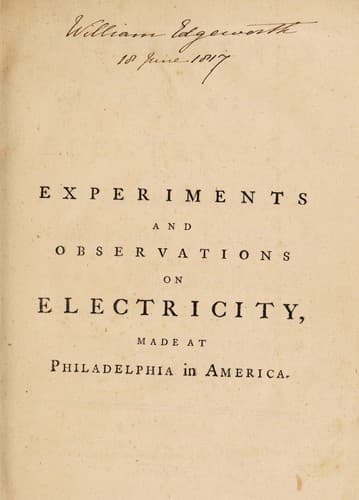
Experiments and Observations on Electricity Made at Philadelphia in AmericaFranklin, Benjamin
History
Experiments and Observations on Electricity Made at Philadelphia in America
Franklin, Benjamin
Electricity -- Early works to 1850
16. The atmosphere of electrical particles surrounding an electrified
sphere, is not more disposed to leave it or more easily drawn off from any
one part of the sphere than from another, because it is equally attracted
by every part. But that is not the case with bodies of any other figure.
From a cube it is more easily drawn at the corners than at the plane sides,
and so from the angles of a body of any other form, and still most easily
from the angle that is most acute. Thus if a body shaped as A, B, C, D, E,
in Fig. 8, be electrified, or have an electrical atmosphere communicated to
it, and we consider every side as a base on which the particles rest and by
which they are attracted, one may see, by imagining a line from A to F, and
another from E to G, that the portion of the atmosphere included in F, A,
E, G, has the line A, E, for its basis. So the portion of atmosphere
included in H, A, B, I, has the line A, B, for its basis. And likewise the
portion included in K, B, C, L, has B, C, to rest on; and so on the other
side of the figure. Now if you would draw off this atmosphere with any
blunt smooth body, and approach the middle of the side A, B, you must come
very near before the force of your attracter exceeds the force or power
with which that side holds its atmosphere. But there is a small portion
between I, B, K, that has less of the surface to rest on, and to be
attracted by, than the neighbouring portions, while at the same time there
is a mutual repulsion between its particles and the particles of those
portions, therefore here you can get it with more ease or at a greater
distance. Between F, A, H, there is a larger portion that has yet a less
surface to rest on and to attract it; here therefore you can get it away
still more easily. But easiest of all between L, C, M, where the quantity
is largest, and the surface to attract and keep it back the least. When you
have drawn away one of these angular portions of the fluid, another
succeeds in its place, from the nature of fluidity and the mutual repulsion
beforementioned; and so the atmosphere continues flowing off at such angle,
like a stream, till no more is remaining. The extremities of the portions
of atmosphere over these angular parts are likewise at a greater distance
from the electrified body, as may be seen by the inspection of the above
figure; the point of the atmosphere of the angle C, being much farther from
C, than any other part of the atmosphere over the lines C, B, or B, A: And
besides the distance arising from the nature of the figure, where the
attraction is less, the particles will naturally expand to a greater
distance by their mutual repulsion. On these accounts we suppose
electrified bodies discharge their atmospheres upon unelectrified bodies
more easily and at a greater distance from their angles and points than
from their smooth sides.--Those points will also discharge into the air,
when the body has too great an electrical atmosphere, without bringing any
Public-domain text, read in full here on John Shaqi.
Reviews
Reviews
No reviews yet
Be the first to share your thoughts on this work.
Join the Discussion
Join the discussion
Sign in to leave a comment or review.
Sign InorCreate an account