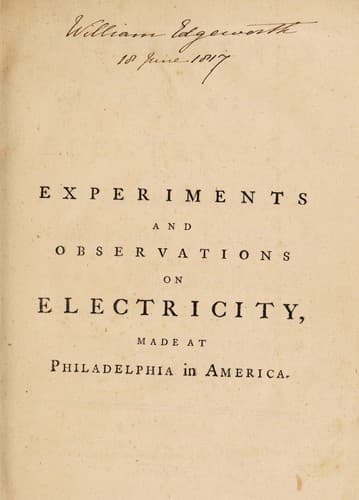
Experiments and Observations on Electricity Made at Philadelphia in AmericaFranklin, Benjamin
History
Experiments and Observations on Electricity Made at Philadelphia in America
Franklin, Benjamin
Electricity -- Early works to 1850
19. Nor is it of much importance to us, to know the manner in which nature
executes her laws; 'tis enough if we know the laws themselves. 'Tis of real
use to know, that china left in the air unsupported will fall and break;
but _how_ it comes to fall, and _why_ it breaks, are matters of
speculation. 'Tis a pleasure indeed to know them, but we can preserve our
china without it.
20. Thus in the present case, to know this power of points, may possibly be
of some use to mankind, though we should never be able to explain it. The
following experiments, as well as those in my first paper, show this power.
I have a large prime conductor made of several thin sheets of Fuller's
pasteboard form'd into a tube, near 10 feet long and a foot diameter. It is
cover'd with _Dutch_ emboss'd paper, almost totally gilt. This large
metallic surface supports a much greater electrical atmosphere than a rod
of iron of 50 times the weight would do. It is suspended by silk lines, and
when charg'd will strike at near two inches distance, a pretty hard stroke
so as to make one's knuckle ach. Let a person standing on the floor present
the point of a needle at 12 or more inches distance from it, and while the
needle is so presented, the conductor cannot be charged, the point drawing
off the fire as fast as it is thrown on by the electrical globe. Let it be
charged, and then present the point at the same distance, and it will
suddenly be discharged. In the dark you may see a light on the point, when
the experiment is made. And if the person holding the point stands upon
wax, he will be electrified by receiving the fire at that distance. Attempt
to draw off the electricity with a blunt body, as a bolt of iron round at
the end and smooth (a silversmith's iron punch, inch-thick, is what I use)
and you must bring it within the distance of three inches before you can do
it, and then it is done with a stroke and crack. As the pasteboard tube
hangs loose on silk lines, when you approach it with the punch iron, it
likewise will move towards the punch, being attracted while it is charged;
but if at the same instant a point be presented as before, it retires
again, for the point discharges it. Take a pair of large brass scales, of
two or more feet beam, the cords of the scales being silk. Suspend the beam
by a packthread from the cieling, so that the bottom of the scales may be
about a foot from the floor: The scales will move round in a circle by the
untwisting of the packthread. Set the iron punch on the end upon the floor,
in such a place as that the scales may pass over it in making their circle:
Then electrify one scale by applying the wire of a charged phial to it. As
they move round, you see that scale draw nigher to the floor, and dip more
when it comes over the punch; and if that be placed at a proper distance,
the scale will snap and discharge its fire into it. But if a needle be
stuck on the end of the punch, its point upwards, the scale, instead of
Public-domain text, read in full here on John Shaqi.
Reviews
Reviews
No reviews yet
Be the first to share your thoughts on this work.
Join the Discussion
Join the discussion
Sign in to leave a comment or review.
Sign InorCreate an account