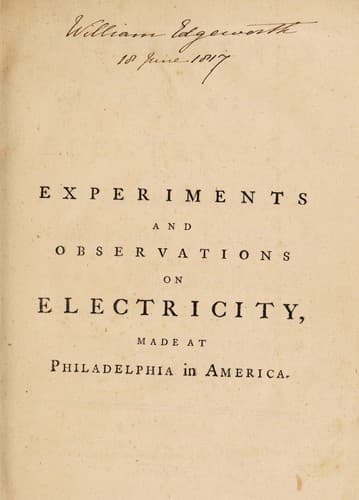
Experiments and Observations on Electricity Made at Philadelphia in AmericaFranklin, Benjamin
History
Experiments and Observations on Electricity Made at Philadelphia in America
Franklin, Benjamin
Electricity -- Early works to 1850
24. Lightning melts metals, and I hinted in my paper on that subject, that
I suspected it to be a cold fusion; I do not mean a fusion by force of
cold, but a fusion without heat. We have also melted gold, silver, and
copper, in small quantities, by the electrical flash. The manner is this:
Take leaf gold, leaf silver, or leaf gilt copper, commonly called leaf
brass or _Dutch_ gold: cut off from the leaf long narrow strips the breadth
of a straw. Place one of these strips between two strips of smooth glass
that are about the width of your finger. If one strip of gold, the length
of the leaf, be not long enough for the glass, add another to the end of
it, so that you may have a little part hanging out loose at each end of the
glass. Bind the pieces of glass together from end to end with strong silk
thread; then place it so as to be part of an electrical circle, (the ends
of gold hanging out being of use to join with the other parts of the
circle) and send the flash through it, from a large electrified jar or
sheet of glass. Then if your strips of glass remain whole, you will see
that the gold is missing in several places, and instead of it a metallic
stain on both the glasses; the stains on the upper and under glass exactly
similar in the minutest stroke, as may be seen by holding them to the
light; the metal appeared to have been not only melted, but even vitrified,
or otherwise so driven into the pores of the glass, as to be protected by
it from the action of the strongest _Aqua Fortis_ and _Ag: Regia_. I send
you enclosed two little pieces of glass with these metallic stains upon
them, which cannot be removed without taking part of the glass with them.
Sometimes the stain spreads a little wider than the breadth of the leaf,
and looks brighter at the edge, as by inspecting closely you may observe in
these. Sometimes the glass breaks to pieces: once the upper glass broke
into a thousand pieces, looking like coarse salt. These pieces I send you,
were stain'd with _Dutch_ gold. True gold makes a darker stain, somewhat
reddish; silver, a greenish stain. We once took two pieces of thick
looking-glass, as broad as a Gunter's scale, and 6 inches long; and placing
leaf gold between them, put them betwixt two smoothly plain'd pieces of
wood, and fix'd them tight in a book-binder's small press; yet though they
were so closely confined, the force of the electrical shock shivered the
glass into many pieces. The gold was melted and stain'd into the glass as
usual. The circumstances of the breaking of the glass differ much in making
the experiment, and sometimes it does not break at all: but this is
constant, that the stains in the upper and under pieces are exact
counterparts of each other. And though I have taken up the pieces of glass
between my fingers immediately after this melting, I never could perceive
the least warmth in them.
Public-domain text, read in full here on John Shaqi.
Reviews
Reviews
No reviews yet
Be the first to share your thoughts on this work.
Join the Discussion
Join the discussion
Sign in to leave a comment or review.
Sign InorCreate an account