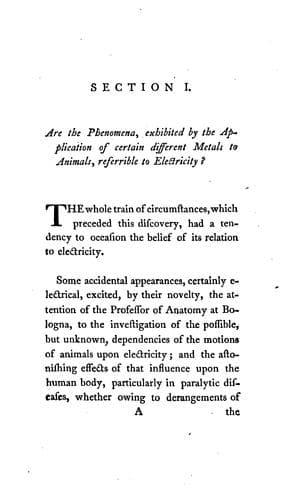
Experiments and Observations Relative to the Influence Lately Discovered by M. Galvani and Commonly Called Animal ElectricityFowler, Richard
Science
Experiments and Observations Relative to the Influence Lately Discovered by M. Galvani and Commonly Called Animal Electricity
Fowler, Richard
Electrophysiology -- Early works to 1800; Galvani, Luigi, 1737-1798
The influence discovered by Galvani appeared to me an admirable test,
by which something decisive might be ascertained relative to these
important points in the physiology of animals, and as such I have
employed it in the following experiments.
Considering, therefore, the brain on the one hand, and the sanguiferous
system on the other, as the possible sources from which nerves and
muscles might derive their power, I began by comparing the effects
which result from interrupting their communication, first with the
brain, and then with the arteries. This mode of procedure seemed to
afford the best prospect of information with respect to every object
which I had in view, but particularly with regard to the relations
which this influence may bear to the several parts examined.
Before relating the experiments, I must observe that the comparison was
instituted between the effects of only partially interrupted
communication; since it must be obvious that a complete interruption,
either of nervous or of arterious communication between any part of an
animal, and the rest of its body, could not have been effected without
so far injuring the animal, as to render the result fallacious.
_Experiments in which the Sciatic Nerves of Frogs were divided._
EXPERIMENT I.
I divided the sciatic nerve, on one side only, in four large frogs. The
division was made at the very top of their thighs, and before the nerve
had given off the first large branch to the muscles of the thigh. This
nerve lies immediately underneath the large crural artery, to which it
is closely attached by a sheath of fine but very strong cellular
membrane. A small nerve, which supplies some of the muscles on the
under side of the thigh, was suffered to remain undivided. The legs,
whose nerves had been divided, became completely paralytic below the
knee, and very nearly so above it. These legs too, immediately after
the division of their nerves, contracted vigorously when laid upon
zinc, and excited by passing a rod of silver in contact with the under
part of the knee till it touched the zinc; but the other legs which
were suffered to remain in their natural state, in order that the
contractility of one leg might all along be compared with that of the
other, did not contract when the metals were similarly applied to them.
These frogs were all killed by cutting off their heads; the first, at
the end of two days after dividing the nerve; the second, at the end of
five days; the third, at the end of seven; and the fourth, at the end
of nine. Their legs were carefully examined, in the manner I have
described, four or five times every day after their heads had been
taken off, so long as any contractions could be excited; but I could
not perceive, in any one of these instances, that the contractile power
continued either longer or more vigorous in the legs, in which the
nerves were not divided than it did in those in which they were.
Public-domain text, read in full here on John Shaqi.
Reviews
Reviews
No reviews yet
Be the first to share your thoughts on this work.
Join the Discussion
Join the discussion
Sign in to leave a comment or review.
Sign InorCreate an account