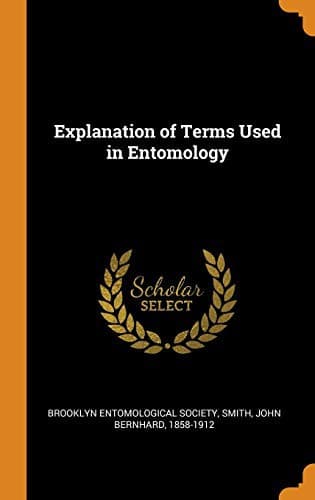
Explanation of Terms Used in Entomology — John Shaqi
Explanation of Terms Used in EntomologySmith, John Bernhard
Science
Explanation of Terms Used in Entomology
Smith, John Bernhard
Insects -- Nomenclature
Cardo, pl. Cardines: the hinge or basal sclerite of the maxilla by
means of which it is jointed to the head.
Carina -ae: an elevated ridge or keel, not necessarily high or acute.
Carinate: a surface having carinae.
Carinula -ae: a little carina or keel-like ridge; specifically, the
longitudinal elevation on the middle of snout in Rhynchophora.
Carinulate: a surface with small and rather numerous carinae.
Cariose -ous: corroded; appearing as if worm-eaten.
Carminate -ed: mixed or tinged with carmine.
Carneous -eus: flesh-colored [salmon with a little carmine].
Carnivorous: a feeder upon flesh food.
Cariose -us: of a soft, fleshy substance.
Carolinian faunal area: that area of the upper austral zone comprising
the larger part of the Middle States (except the mountains), s. e. So.
Dakota, east. Nebraska, Kansas and part of Oklahoma; nearly all of
Iowa, Missouri, Illinois, Indiana, Ohio, Maryland and Delaware; more
than half of West Virginia, Kentucky, Tennessee and New Jersey and
large areas in Alabama, Georgia, the Carolinas, Virginia,
Pennsylvania, New York, Michigan and South Ontario: extends along
Atlantic Coast from near mouth of Chesapeake Bay to Southern
Connecticut and sends narrow arms up the valleys of the Hudson and
Connecticut. A narrow arm follows the east shore of Lake Michigan to
Grand Traverse Bay.
Carpus: the pterostigma of Odonata: the extremity of the radius and
cubitus of the primaries: that point in the wings at which they are
tratsversely folded.
Cartilaginous: of the consistency of cartilage or gristle.
Caruncle: a soft, naked, fleshy excrescence or protuberance.
Caryophylleous: nut or clove brown [Indian red].
Castaneous: chestnut brown; bright red-brown [dragon's blood with a
slight admixture of vermilion].
Castes: the various forms or kinds of matured individuals among
social insects as workers, soldiers, queens, etc.
Cataphracted: invested with a hard callous skin, or with scales closely
united. Catch: in Collembola, = tenaculum, q.v.
Catenate: with longitudinal connected elevations like links in a chain.
Catenulate: like catenate; but the links are smaller.
Caterpillar: the term applied to the larvae of Lepidoptera.
Catervatum: by heaps.
Caudal: the tail: any process resembling a tail: the pointed end of the
abdomen in plant lice: any extension of the anal segment or
appendage terminating the abdomen.
Caudad: toward the posterior end of the body, along the median line.
Caudal: pertaining to the posterior or anal extremity.
Caudal setae: long, thread-like processes at the end of the abdomen in
many europterous and some other insects; = anal filaments.
Caudate: with tail-like extensions or processes.
Caudo-cephalic: in a line from the head to the tail.
Caudo-dorsad: directed upward and toward the tail.
Caudula -ae: a little tail.
Caul: the fatty mass of larvae from which the organs of the future
adult were supposed to develop: = epiploon.
Public-domain text, read in full here on John Shaqi.
Reviews
Reviews
No reviews yet
Be the first to share your thoughts on this work.
Join the Discussion
Join the discussion
Sign in to leave a comment or review.
Sign InorCreate an account