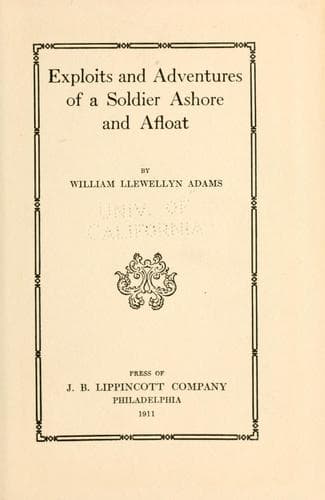
Exploits and adventures of a soldier ashore and afloatAdams, William Llewellyn
History
Exploits and adventures of a soldier ashore and afloat
Adams, William Llewellyn
Adams, William Llewellyn; Americans -- Foreign countries; United States. Army -- Military life
The noise, which up to this time has been violent, here breaks into a
paroxysm of tumultuous disorder. Each spectator is yelling for his
favorite bird, which he designates by its color; this singsong
chatter, being a jumble of the Spanish, Tagalog, and Chinese tongues,
runs like this: Color row, color row, blanco, Ki tim chung a wong,
blanco, blanco, Ki tim chung a wong, negro, negro, negro, focho, color
row, blanco, Ki tim chung a wong. This is grand music for mutes and
boiler-makers! The spurs, unlike the sharp-pointed gaff’s used on
American game-cocks, are small steel blades shaped like a razor and
honed to an extreme degree of keenness. After the spurs are fastened
on and each Filipino is satisfied with the ire of his bird, they are
pitted, the owners leave the pit, and the battle is waged; not in
accordance with Dr. Clark’s rules of the United States, however, as
cock-fighting was in vogue in the Philippines for ages before the
discovery of America.
As the battle is waged, each bird seems conscious of the dire effects
of the fatal blade of its adversary; they strut, crouch, and spar,
each with eyes intent on the slightest move of the other. “Mucho bueno
combati este negro,” shouts the Filipino as the red fowl narrowly
escapes a lunge from the spur of the black. “Negro, negro, buena negro
minok,” shout the backers of the black fowl, which, unlike in the case
of the opponents in a prize-fight, the applause tends to intimidate,
rather than inspire courage in the feathery tribe. “Spearo poco
tiempo,” exclaims the red fowl’s admirer. “Caramba spearo,” cries the
follower of the black with vehemence; “poco tiempo, este negro, murto
este outro minok, tiene mucho jinero fora compra chow fora pickinniny,
no mas traubaho.” This mixture of Igorrote and Tagalog translated
means, “There will be a hot time in one nippa shack if the black bird
wins.”
“Aha!” is uttered in crescendo. They have struck; feathers fly over
the pit, and blood flows from the red fowl; they strike again, the red
bird limps, and is seen to run, followed by the black, which is
bleeding profusely from a gash hidden by its feathers; this brings
forth tremendous cheers, which, however, die down as the crucial
moment is observed. “Can it come back?” Both are weakening; the red
game turns, with that blind spontaneity and instinct animated by fear;
they crouch and strike together; a spur has reached the vital spot;
the black swoons, its vital functions have ceased, and the battle is
at an end. As the red fowl is proclaimed the winner, it is seen to
sink, game to the last second; with its life it has paid the price of
the victory.
“They are dead game chickens,” remarks a soldier as they are carried
from the pit. Bets are now paid off, and the pit is sprinkled with
fresh sand, new wagers are laid, and the main continues.
Public-domain text, read in full here on John Shaqi.
Reviews
Reviews
No reviews yet
Be the first to share your thoughts on this work.
Elsewhere in the archive
Join the Discussion
Join the discussion
Sign in to leave a comment or review.
Sign InorCreate an account